Bumthang Bhutan: Four Valleys, Sacred Monasteries & Spiritual Heart
Last updated:
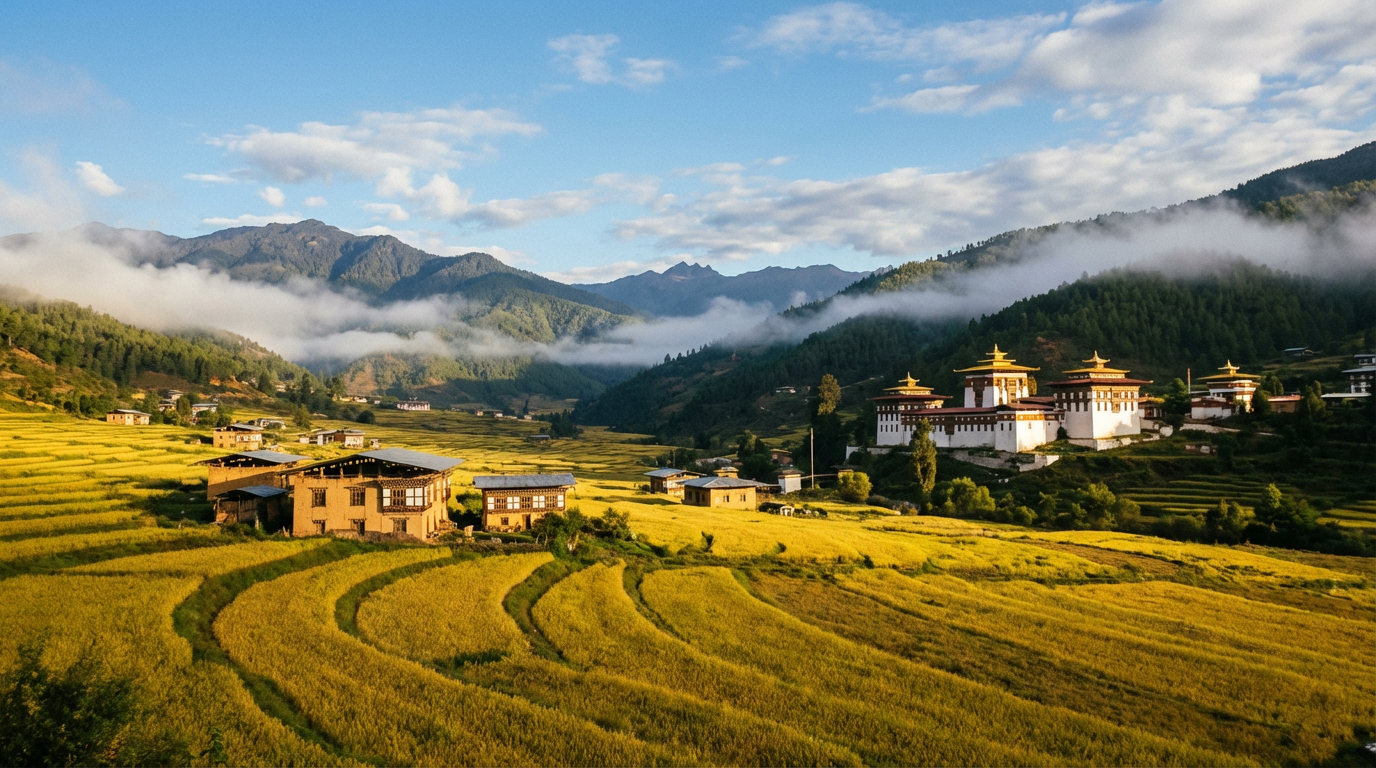
Bumthang is the spiritual heart of Bhutan – a region that deeply touches even experienced Himalayan travelers. In four valleys, nestled between 2,600 and 4,000 meters elevation, stand the oldest Buddhist temples in the country, where Guru Rinpoche meditated in the 8th century and the legendary treasure finder Pema Lingpa discovered his sacred texts. Here, far from the main tourist routes, pulses the authentic heart of Bhutan: In Chumey's weaving workshops emerge the nation's most beautiful fabrics, Jakar's only brewery brews its beer, and monks in the monasteries live as they have for centuries. Those who visit Bumthang experience a Bhutan that is barely found anymore in the west.
Bumthang at a Glance
The name "Bumthang" literally means "beautiful meadow" – and indeed, between high mountains here open wide, gently rolling valleys with golden buckwheat fields and traditional farmhouses. But the true significance runs deeper: Here Buddhism took root in Bhutan, here Guru Rinpoche worked, and here lived Pema Lingpa, whose descendants founded the present royal dynasty. Bumthang is less touristy than western Bhutan – those who come here consciously seek depth over superficiality.
This image was generated with AI.
The Four Valleys of Bumthang – Each Unique
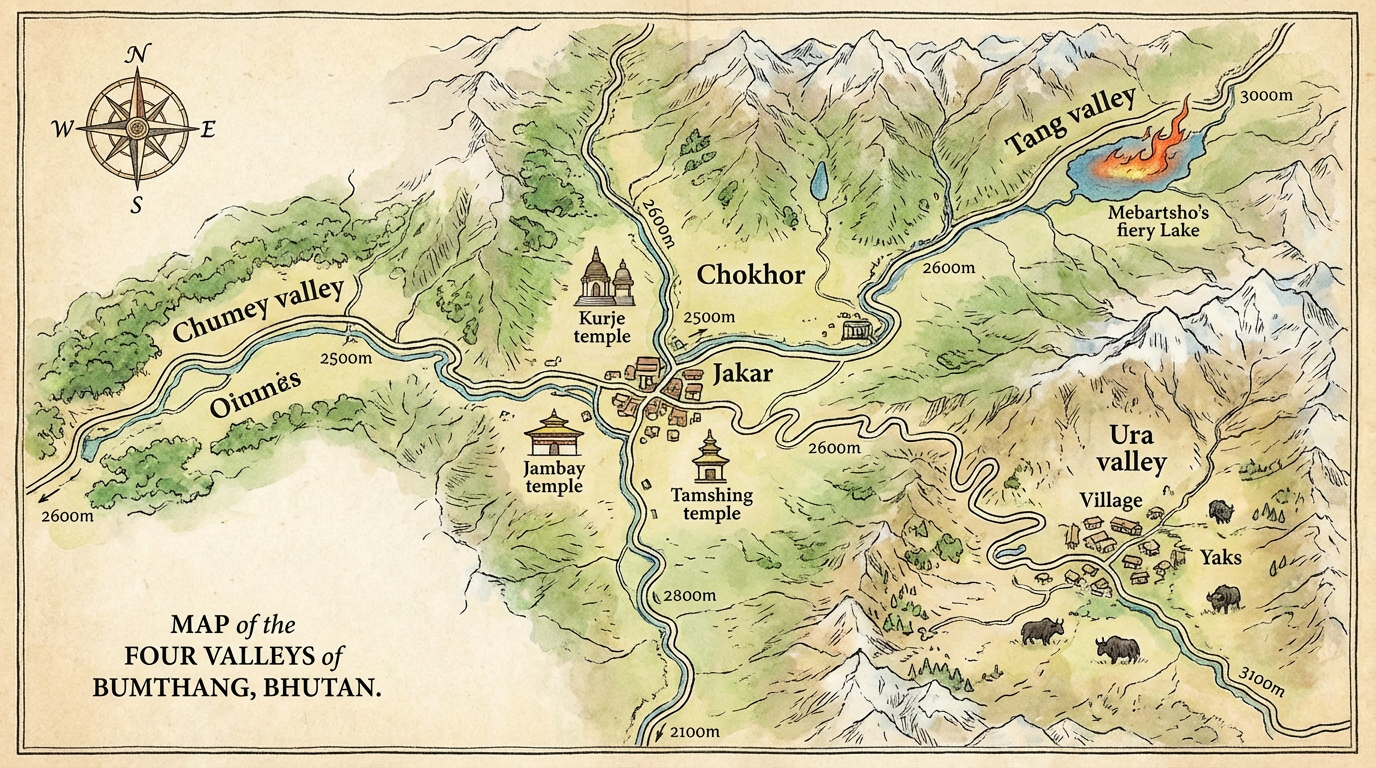
The Bumthang Valley – precisely speaking, it's four connected valleys – extends at different elevations through central Bhutan. Each of these valleys has its own character: busy Chokhor with the holiest temples, craft-focused Chumey with its weaving workshops, remote Tang with pilgrimage sites, and high-altitude Ura with its traditional village. A complete exploration of all four valleys requires at least 3–4 days.
| Valley | Elevation | Character | Main Attractions |
|---|---|---|---|
| Chokhor | approx. 2,600 m | Main valley with Jakar, tourist infrastructure | Kurje, Jambay, Tamshing, Jakar Dzong |
| Chumey | approx. 2,700 m | Crafts and weaving, authentic | Yathra Weaving Studios, Prabaritsa Lhakhang |
| Tang | approx. 2,800 m | Remote, pilgrimage site, yak herding | Mebartsho, Ogyen Choling Palace |
| Ura | approx. 3,100 m | Highest valley, very traditional | Ura Village, Ura Yakchoe Festival |
Chokhor – The Main Valley of Bumthang
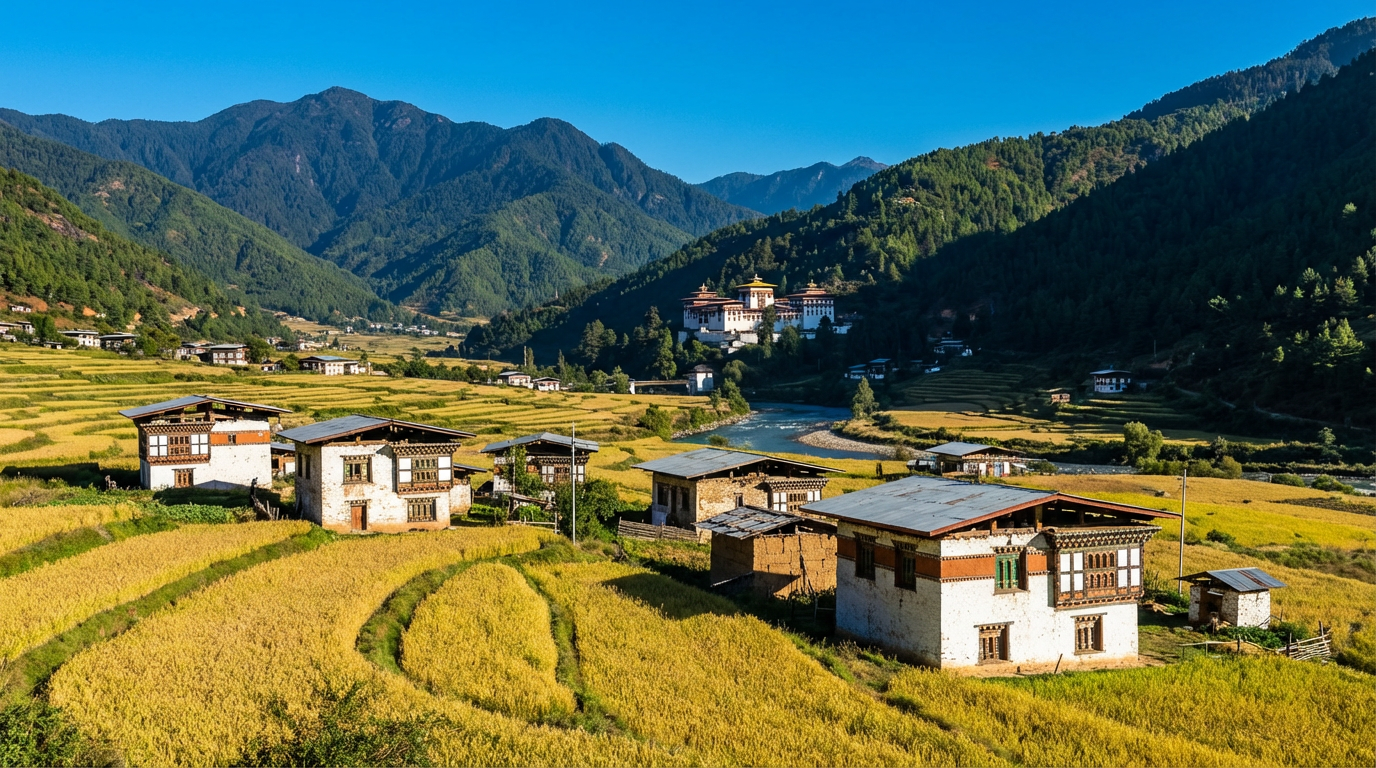
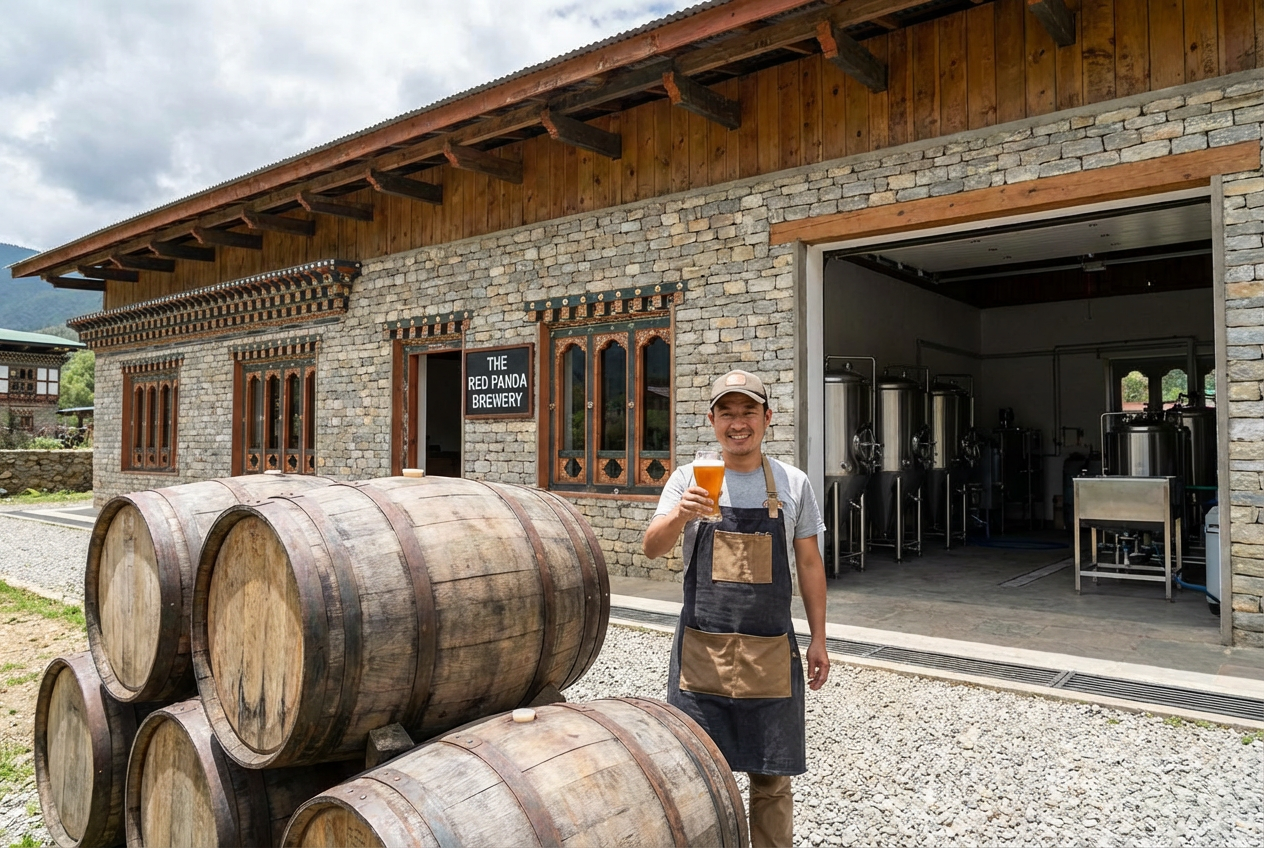
The Chokhor Valley is the heart of Bumthang – here lies the main town of Jakar with its few hotels, restaurants, and shops. The wide, open valley is surrounded by forested mountains and hosts the three most important monasteries of the region: Kurje Lhakhang, Jambay Lhakhang, and Tamshing Lhakhang. A walk between these three sacred sites, passing buckwheat fields and traditional houses, is among the most beautiful experiences in all of Bhutan. In Chokhor Valley is also located the Red Panda Brewery – Bhutan's only brewery.
This image was generated with AI.
Chumey – The Valley of Weavers
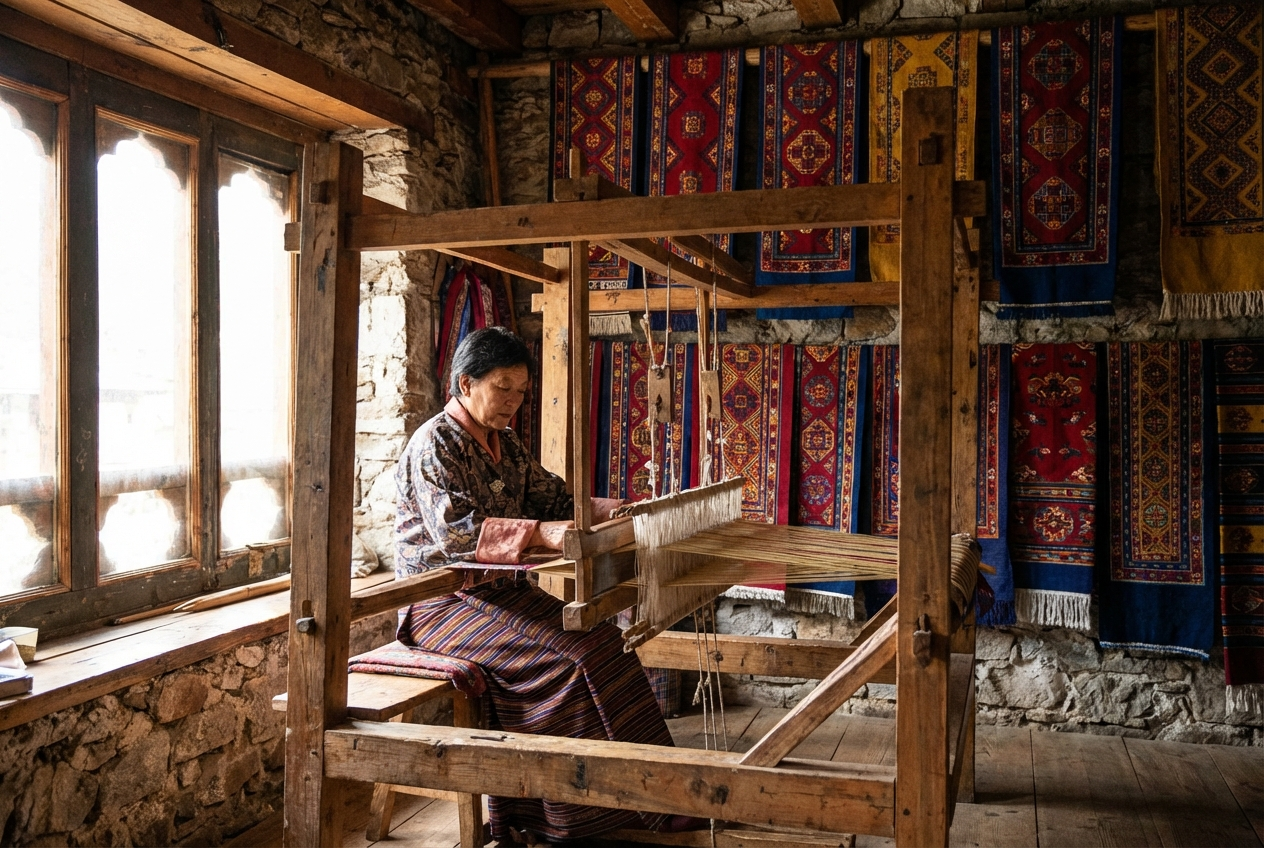
The Chumey Valley, west of Chokhor, is the center of traditional Yathra weaving. These colorful wool fabrics with their characteristic patterns are crafted here by women on traditional looms – an art passed down through generations. Visitors can tour weaving studios, watch the women work, and purchase hand-woven scarves, blankets, or bags as special souvenirs. The valley is less visited than Chokhor and offers an authentic glimpse into rural Bhutan.
Tang – The Remote Valley
The Tang Valley is the most remote of Bumthang's four valleys – and for many visitors, the most fascinating. In a dramatic gorge lies Mebartsho, the "flaming lake," where Pema Lingpa retrieved his sacred treasures from the water – one of Bhutan's most important pilgrimage sites. Higher in the valley towers the Ogyen Choling Palace, a historic manor house that today serves as a museum telling the story of a noble Bhutanese family. The landscape is rugged here, shaped by yak and sheep herding.
Ura – The Highest Valley
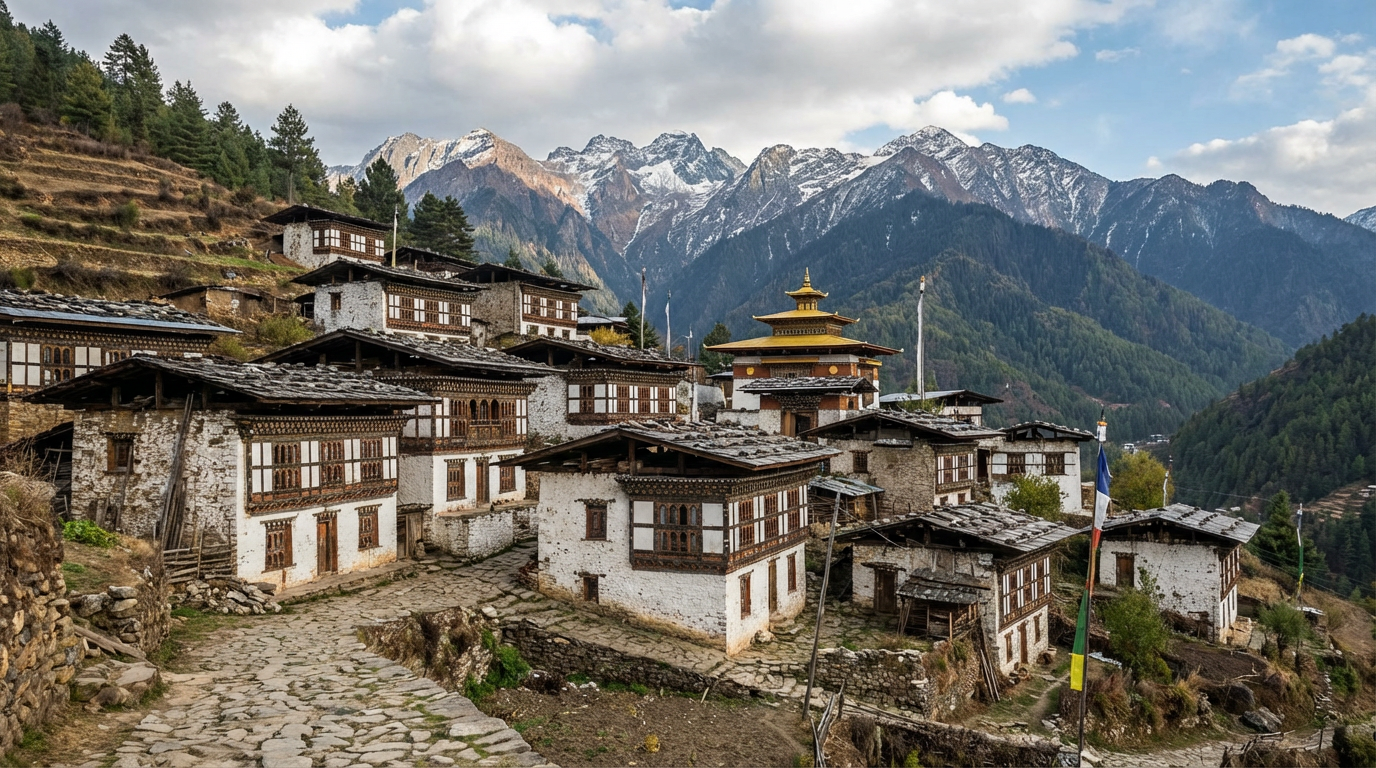
The Ura Valley is the highest and least-visited of the four valleys. To reach it, you cross the spectacular Ura-La Pass at 3,600 meters. The village of Ura itself is a time warp: closely packed traditional houses, cobblestone streets, an ancient atmosphere. The inhabitants live much as they have for centuries. In April or May, the Ura Yakchoe festival takes place here – one of Bhutan's most authentic festivals, rarely visited by tourists.
This image was generated with AI.
The Spiritual Significance of Bumthang
Bumthang is not merely a beautiful region – it is the place where Buddhism took root in Bhutan and remains most deeply rooted today. Two names shape the spiritual landscape: Guru Rinpoche, who worked here in the 8th century and brought Buddhism to Bhutan, and Pema Lingpa, who lived here in the 15th century and whose descendants founded the present royal dynasty. Their traces are everywhere in Bumthang.
Guru Rinpoche – The Bringer of Buddhism
Guru Rinpoche (also called Padmasambhava) is regarded as the founder of Buddhism in the Himalayas. According to legend, he came to Bumthang in the 8th century to heal a seriously ill king. He meditated at the location that is now Kurje Lhakhang, leaving his body imprint in the rock – visible to this day, making the temple one of Bhutan's holiest places. Guru Rinpoche's work in Bumthang marks the beginning of organized Buddhism in Bhutan.
Pema Lingpa – The Legendary Treasure Finder
Pema Lingpa (1450–1521) was one of the most significant religious masters of the Nyingma school and a tertön – a "treasure finder" who discovered sacred texts hidden by Guru Rinpoche. His most famous deed occurred at Mebartsho, the "flaming lake" in Tang Valley: he dove with a burning butter lamp into the water and emerged with a treasure of sacred texts – the lamp still burning. His descendants played a central role in Bhutan's history; the present royal family traces its lineage to him. In Bumthang, his legacy lives on.
"To understand Bumthang, you must visit its temples – but to understand the temples, you must know the story of Guru Rinpoche and Pema Lingpa."
The Major Attractions of Bumthang
Bumthang hosts an extraordinary concentration of sacred sites – some of them among the oldest Buddhist structures in the entire Himalayas. In Chokhor Valley, three of the most important temples are just a walk apart, while Tang Valley is home to Mebartsho, one of the country's most important pilgrimage sites.
Kurje Lhakhang – The Body Imprint of the Guru
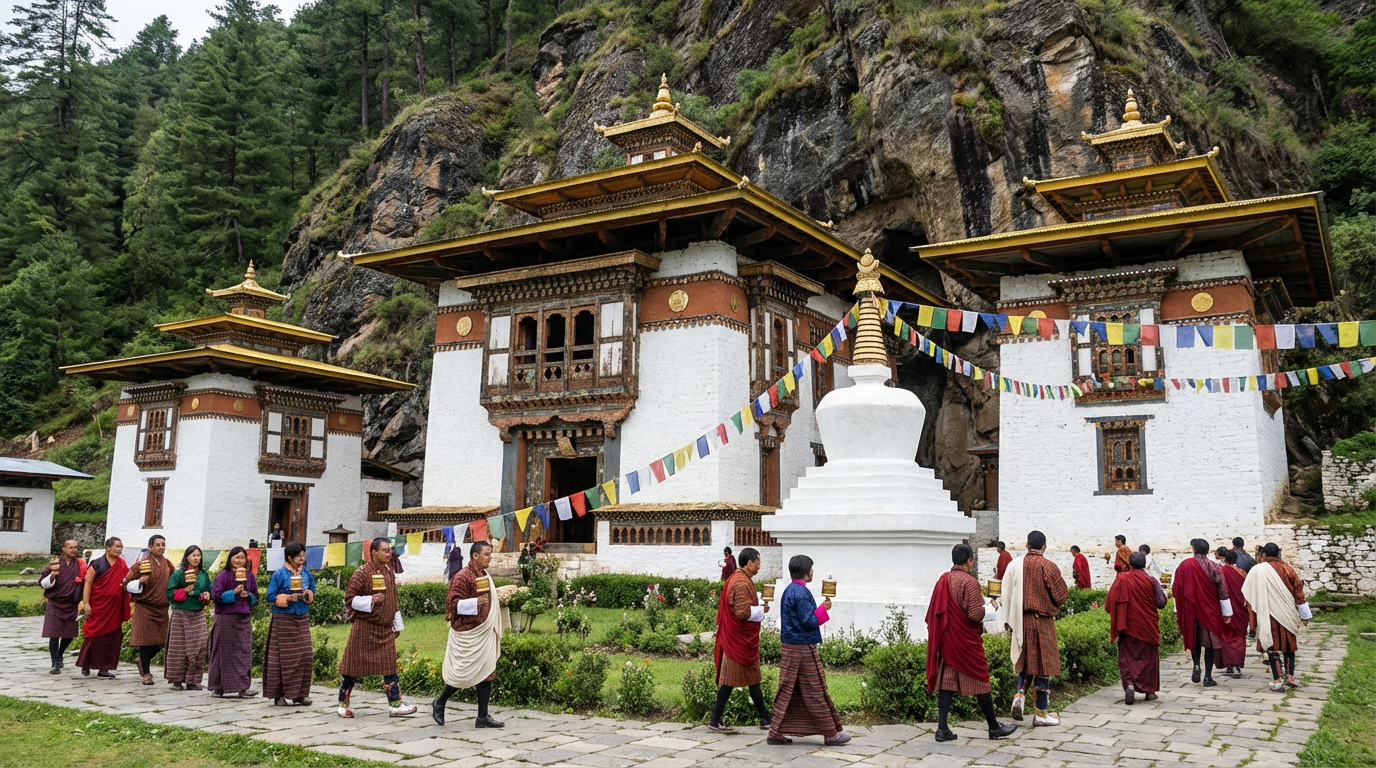
Kurje Lhakhang is one of Bhutan's holiest places and the spiritual heart of Bumthang. The complex consists of three temples nestled against a cliff. In the central temple is the cave where Guru Rinpoche meditated – and his body imprint in the rock is visible to this day (kurje literally means "body imprint"). The atmosphere is one of deep spirituality; pilgrims circumambulate the complex and touch the sacred rock. Those who are receptive sense a special energy here.
This image was generated with AI.
Jambay Lhakhang – One of Bhutan's Oldest Temples
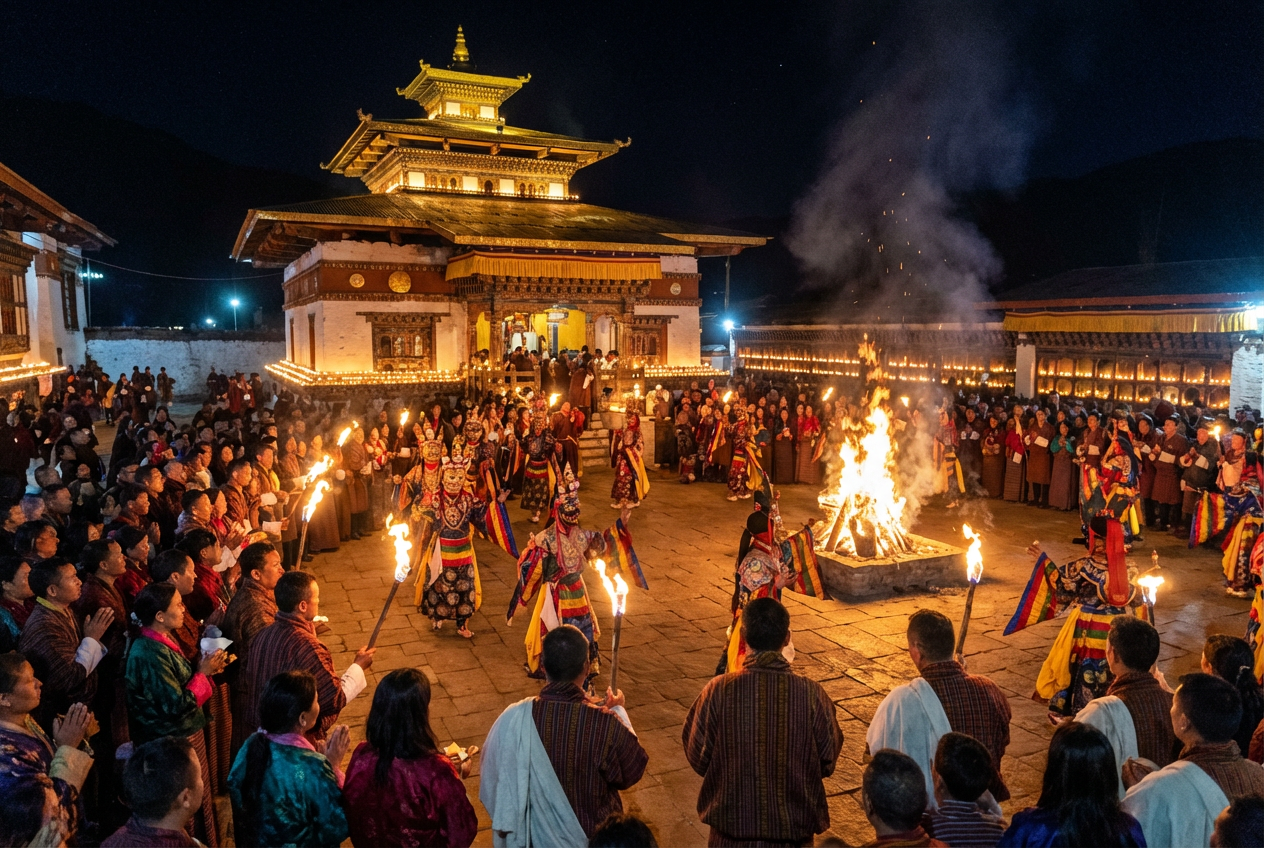
Jambay Lhakhang is among Bhutan's oldest temples – built in the 7th century by Tibetan King Songtsen Gampo as one of 108 temples that legend says were constructed on a single day to subdue a demonic giantess. The temple's core is nearly 1,400 years old, predating Buddhism in Bhutan itself. Jambay Lhakhang is famous for its annual festival Jambay Lhakhang Drup, where the unique nude dance (Tercham) is performed – a fertility ritual seen nowhere else.
Tamshing Lhakhang – The Monastery of Pema Lingpa
Tamshing Lhakhang was founded in 1501 by Pema Lingpa himself and remains connected to his legacy today. Inside are some of Bhutan's oldest and best-preserved murals – direct testimony to 16th-century art. A special experience for pilgrims: you can don a heavy chainmail and circumambulate the temple – a ritual believed to absolve sins.
Jakar Dzong – The "Castle of the White Bird"
Jakar Dzong, also called the "Castle of the White Bird," overlooks Chokhor Valley. The name, according to legend, comes from a white bird that indicated the location. Founded as a monastery in 1549, it now serves as the administrative center for the entire Bumthang region. The Dzong is typically not accessible to visitors, but its majestic appearance defines the valley's character.
Mebartsho – The "Flaming Lake"
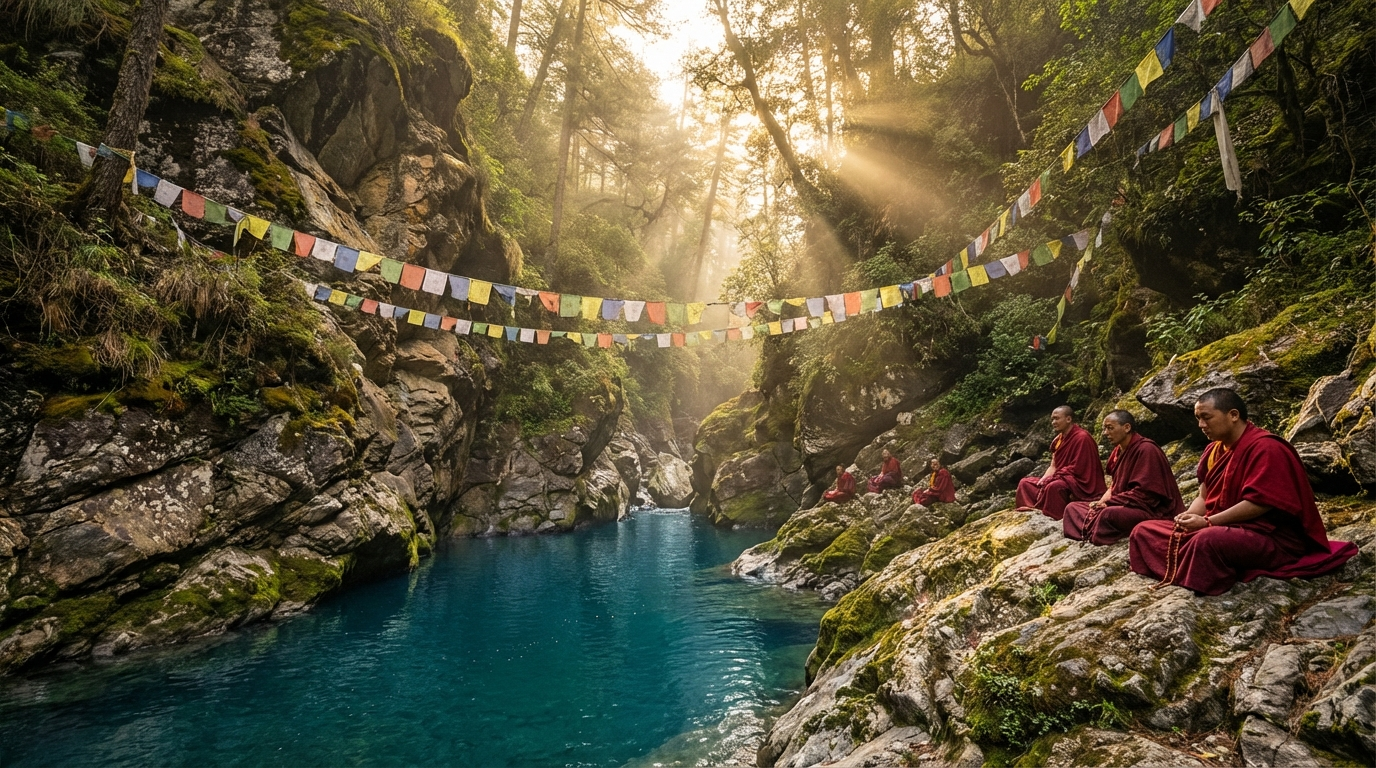
Mebartsho, the "flaming lake," is one of Bhutan's most important pilgrimage sites and inseparably linked to Pema Lingpa. In a deep gorge in Tang Valley, the waters of Tang Chhu gather in a still pool – here Pema Lingpa dove in the 15th century with a burning butter lamp and emerged with a treasure of sacred texts, the flame still burning. Today the place is a pilgrimage destination; the atmosphere in the narrow gorge with its dark waters is mystical and moving. A short hike leads from the parking area to the lake.
This image was generated with AI.
Learn more about monasteries and Dzongs in Bhutan
Local Specialties – Honey, Cheese, and Beer
Bumthang is not only spiritually significant but also culinarily unique. Here are produced items found nowhere else in Bhutan – from honey from the mountain valleys to cheese produced Swiss-style to beer from the country's only brewery. These local specialties are part of the Bumthang experience and make the region interesting for connoisseurs as well.
 Culinary
 This image was generated with AI.
Bumthang Honey
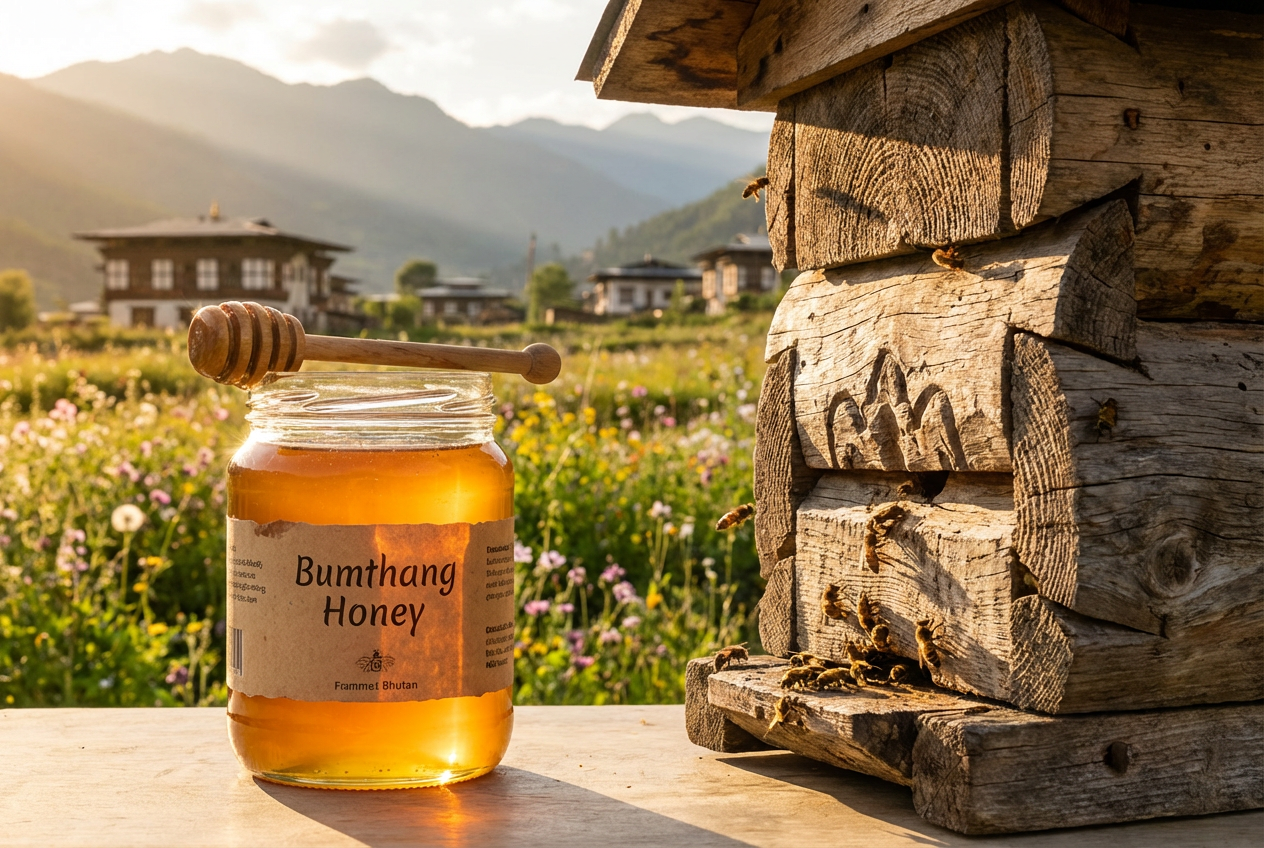
The honey from Bumthang is considered Bhutan's best – bees collect nectar from wild flowers in the high valleys. A popular souvenir.
 Culinary
 This image was generated with AI.
Bumthang Cheese
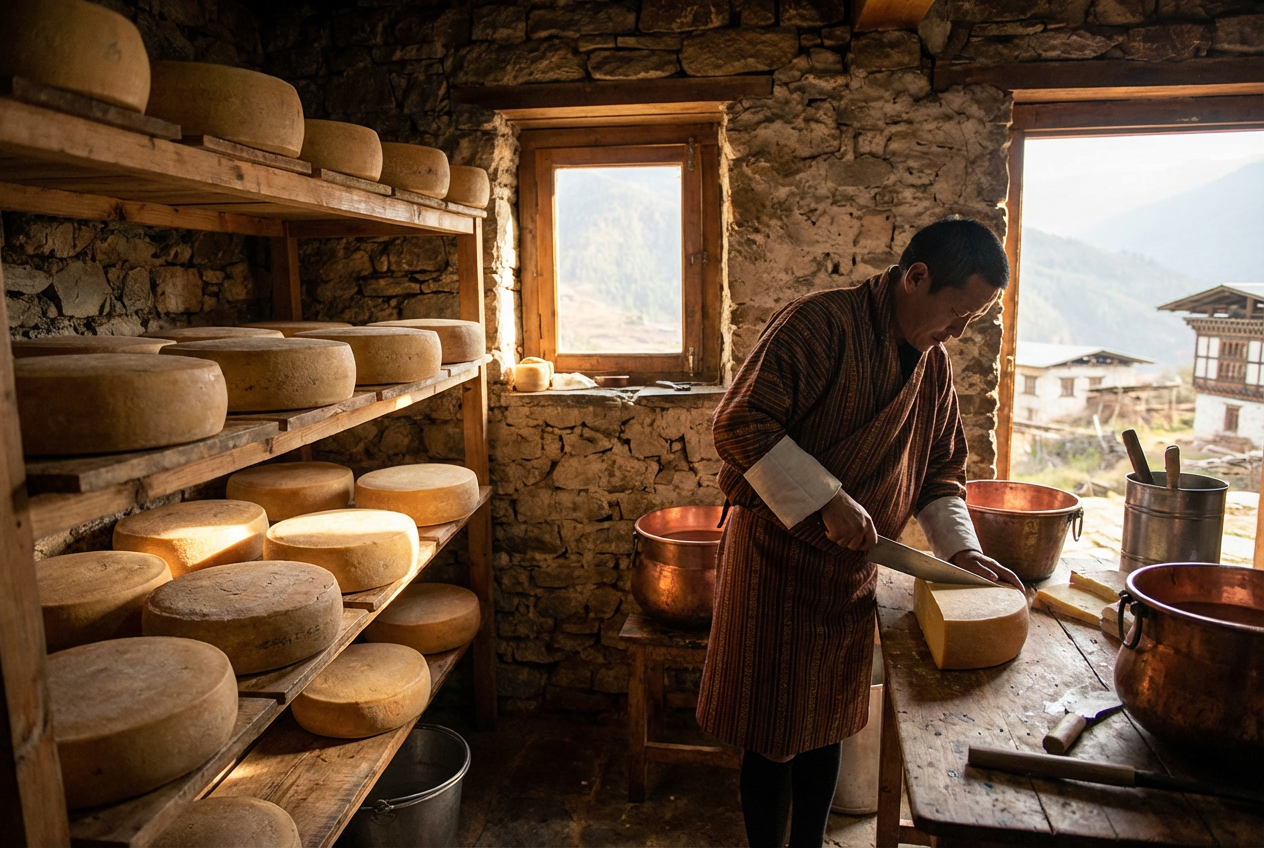
Produced Swiss-style – the cheese tradition was introduced in the 1970s by a Swiss development worker. Today a fixed part of local cuisine.
 Culinary
 This image was generated with AI.
Red Panda Brewery
Bhutan's only brewery produces wheat beer and cider according to German recipes – a visit with tasting is possible.
 Crafts
 This image was generated with AI.
Yathra Weaving
The traditional wool fabrics from Chumey Valley are famous for their patterns and quality. Visit a weaving studio and watch the craftswomen work.
Hiking in Bumthang
The wide valleys and gentle hills of Bumthang invite hiking. From leisurely walks between the three sacred temples in Chokhor Valley to full-day excursions into Ura Valley, the region offers options for different fitness levels. Keep the elevation in mind – at 2,600 to 3,100 meters, hiking is more strenuous than at sea level.
| Hike | Duration | Difficulty | Highlights |
|---|---|---|---|
| Chokhor Temple Circuit | 4–5 hours | Easy to moderate | Kurje, Jambay, Tamshing, buckwheat fields, village life |
| Tang Valley Trail | 5–6 hours | Moderate | Mebartsho, Ogyen Choling Palace, remote villages |
| Ura Valley | Full day | Moderate | Ura-La Pass (3,600 m), traditional village, panoramic views |
| Ngang Lhakhang | 2–3 hours | Easy | "Swan Monastery," serene atmosphere, forest trail |
Festivals in Bumthang
Bumthang is the venue for some of Bhutan's most authentic festivals – less crowded than the major Tshechaus in the west, but no less impressive. Especially Jambay Lhakhang Drup with its unique "nude dance" is an experience you can have only here.
 October/November
 This image was generated with AI.
Jambay Lhakhang Drup
Bumthang's most famous festival – known for the unique 'nude dance' (Tercham), a fertility ritual performed nowhere else.
 June
June This image was generated with AI.
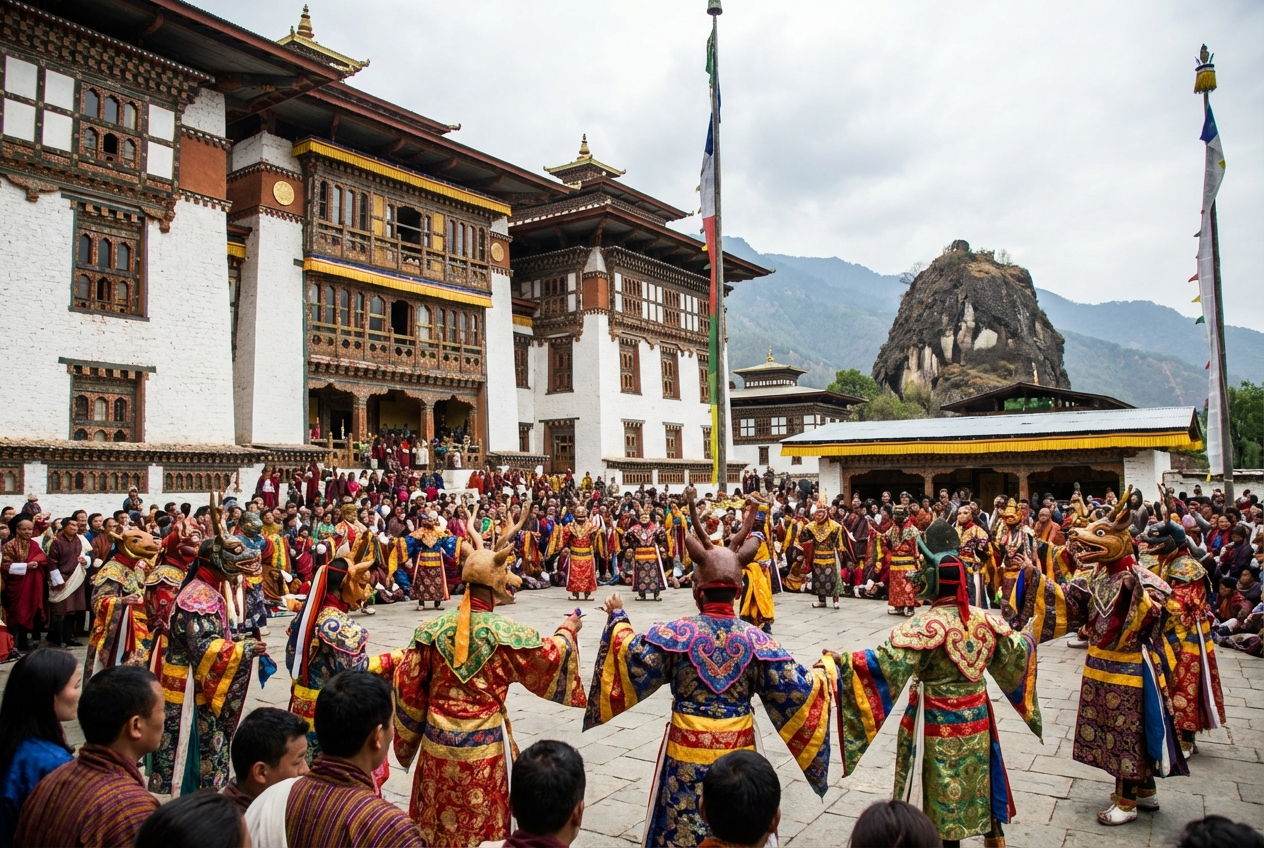
Kurje Tshechu
Traditional mask dance festival at Bumthang's holiest site – in June when the valleys are in full bloom.
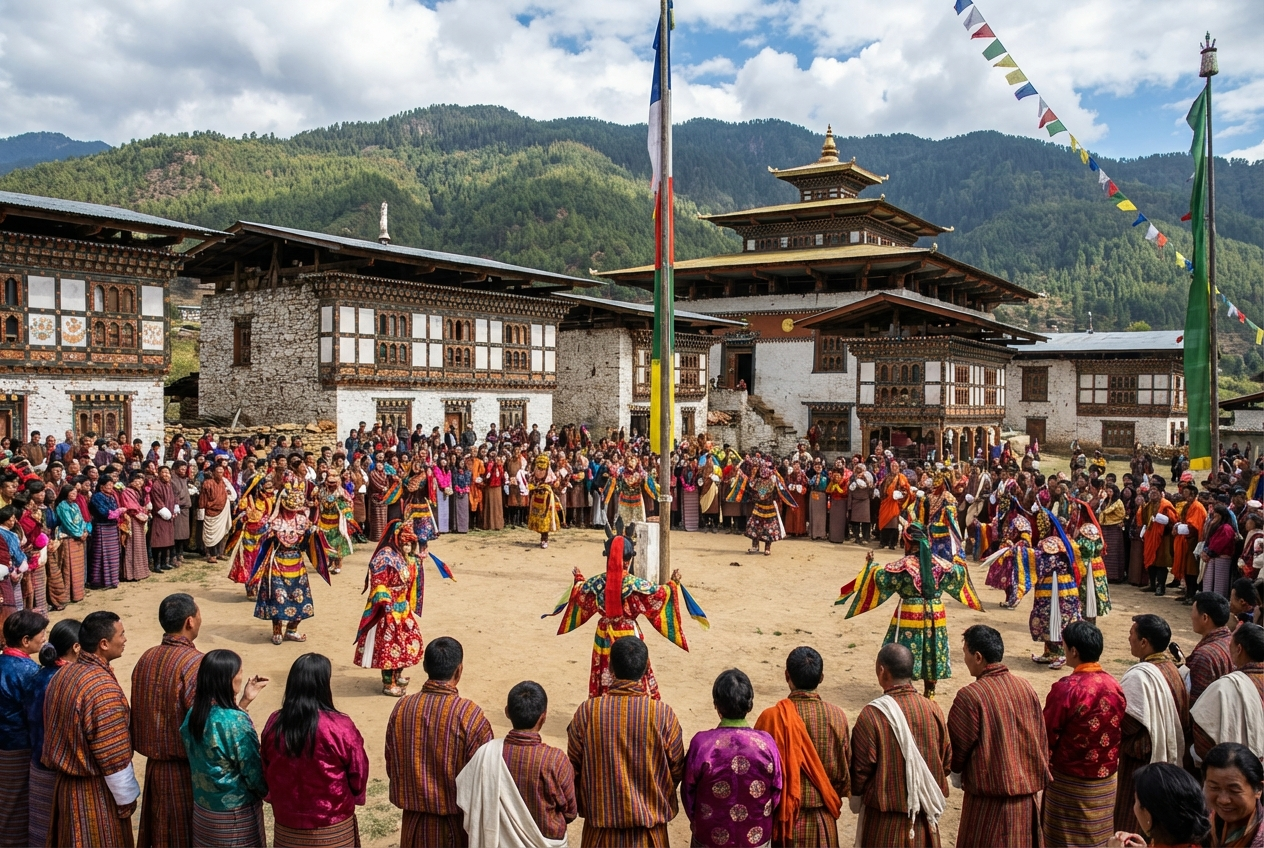 April/May
 This image was generated with AI.
Ura Yakchoe
One of Bhutan's most authentic festivals – in remote Ura Valley, rarely visited by tourists. An experience for true enthusiasts.
Complete Festival Calendar 2026/2026
Hotels and Lodges in Bumthang
Bumthang offers fewer hotels than the more touristic regions in western Bhutan, but the selection is growing. In the luxury segment, you'll find Amankora and Six Senses – two of the country's best properties. For all other budgets, there are comfortable mid-range hotels and authentic guesthouses – all with the region's special charm.
Luxury Lodges
 Ultra-Luxury
 This image was generated with AI.
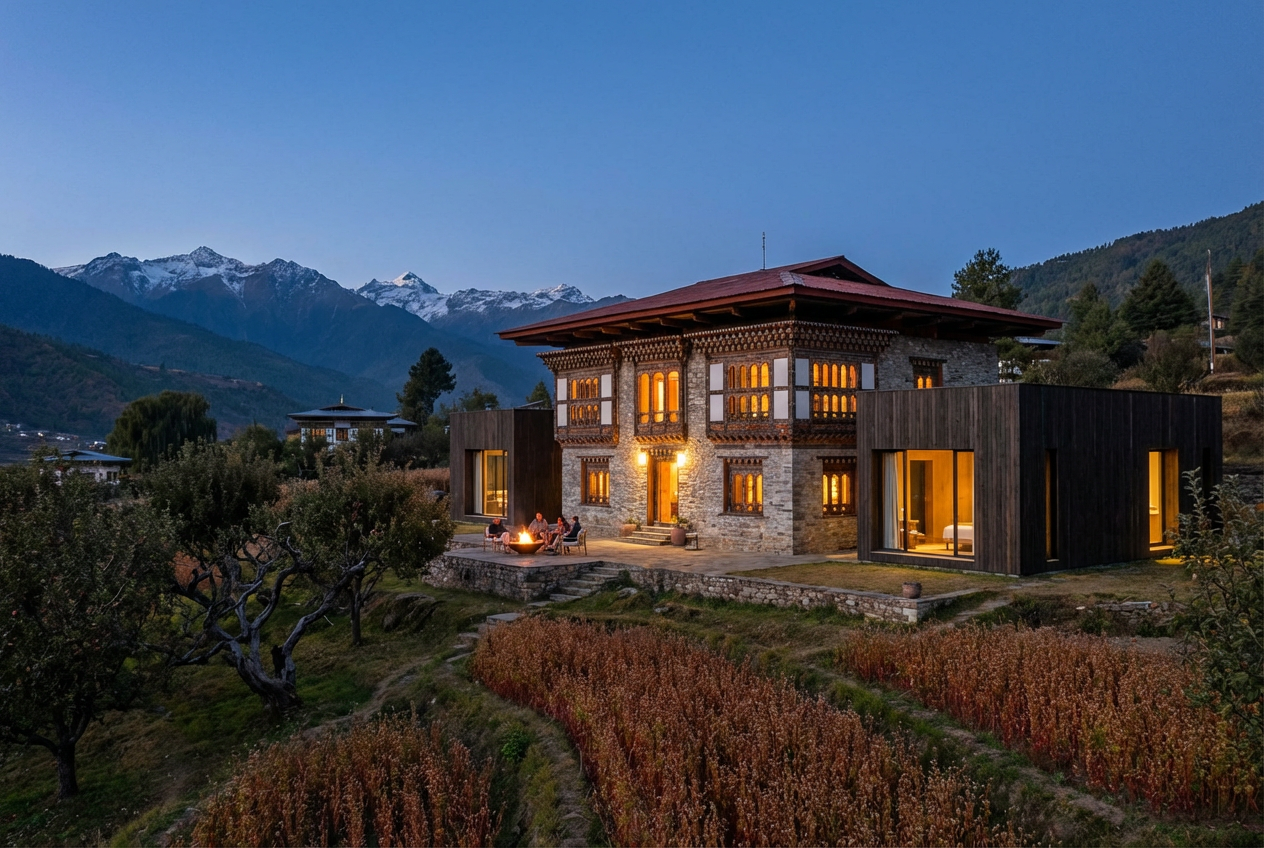
Amankora Bumthang
Aman chain's Bumthang lodge: 16 suites in a restored manor house, surrounded by apple orchards – the easternmost station of the Aman circuit.
 Luxury
 This image was generated with AI.
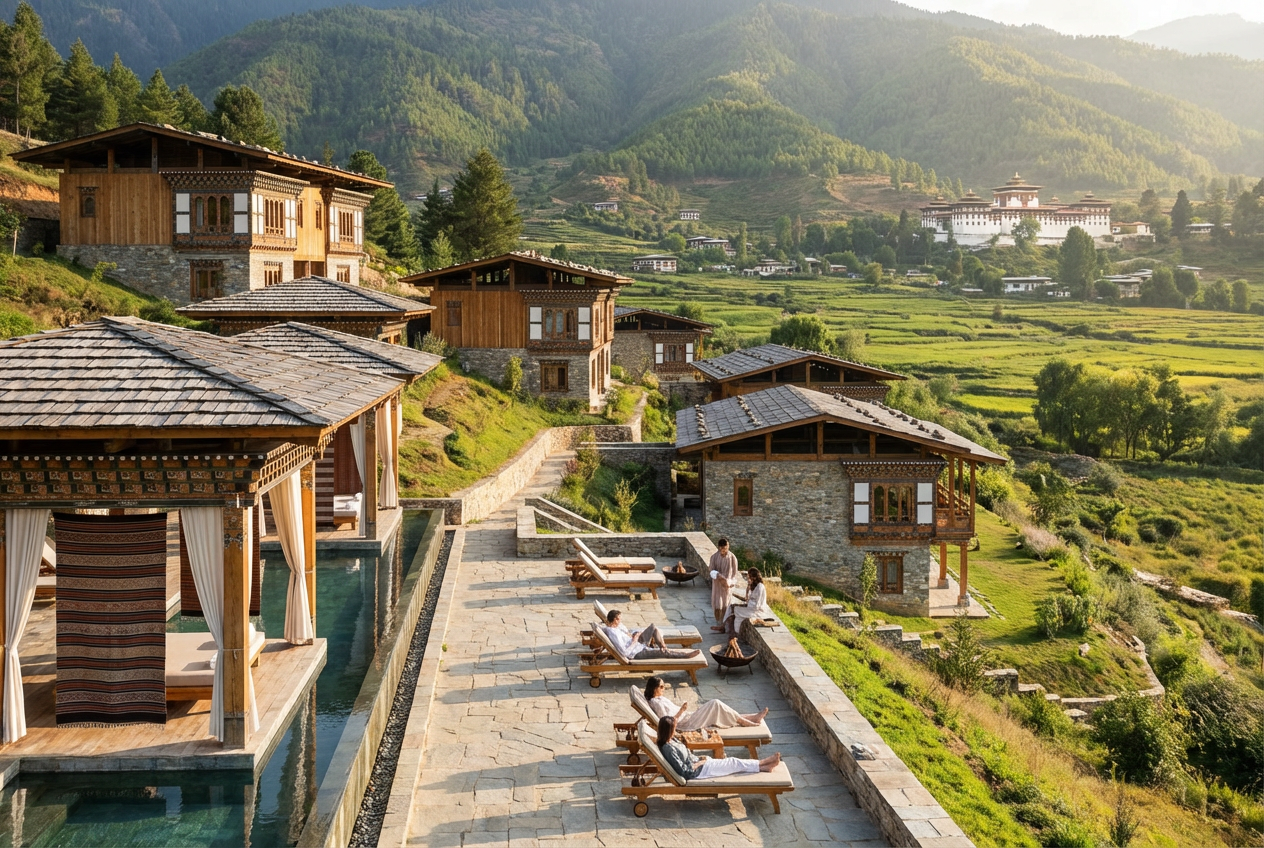
Six Senses Bumthang
Wellness-focused with spa and hot stone baths: The lodge overlooks Chokhor Valley with views of Jakar Dzong – perfect for relaxation after temple visits.
Mid-Range and Guesthouses
Beside the luxury lodges, Bumthang has several comfortable mid-range hotels such as Bumthang Mountain Resort, Rinchenling Lodge, and Jakar Village Lodge. In Jakar itself are simple but clean guesthouses offering authentic experiences at fair prices. Hospitality in Bumthang is legendary.
All accommodations in Bumthang by category
Recommended Stay Duration in Bumthang
For a comprehensive visit to Bumthang, we recommend at least 2 nights, optimally 3–4 nights. The long journey (10–12 hours from Thimphu) justifies an extended stay – those who just pass through miss the essence. Bumthang typically comes at the end of a longer Bhutan trip (10–14+ days) since the journey east takes time.
Minimum: 2 Nights – The Essential Temples
- Day 1: Arrival from Trongsa (2.5–3 hours), afternoon: Jakar Dzong exterior, valley walk, acclimatization
- Day 2: Temple circuit: Kurje Lhakhang, Jambay Lhakhang, Tamshing Lhakhang, afternoon: Red Panda Brewery or cheese factory
- Day 3: Morning: Mebartsho in Tang Valley, onward travel or return
Optimal: 3-4 Nights – Explore Multiple Valleys
- Day 1: Arrival, settle in and acclimatize
- Day 2: Temple circuit in Chokhor Valley
- Day 3: Tang Valley: Mebartsho, Ogyen Choling Palace
- Day 4: Excursion to Ura Valley via Ura-La Pass, or Chumey Valley with weaving studios
- Day 5: Onward travel or relaxed morning before departure
Festival Time: 4+ Nights – For Jambay Lhakhang Drup
- Recommendation: Plan at least 4 nights to enjoy the festival without rush
- Festival Days: The nude dance occurs at night – plan rest time the next day
- Combination: Combine the festival with excursions to other valleys on festival-free days
- Note: Hotels are in high demand at this time – book early!
Weather in Bumthang and Best Time to Visit
Bumthang sits at 2,600 to 4,000 meters elevation and has a cooler climate than the lower regions in the west. The four seasons are distinctly felt here: cold winters with occasional snow, mild springs with blossoms, moderate summers, and clear autumn days. Pack warm clothing for evenings even in summer.
| Period | Day Temp | Night Temp | Weather | Suitability |
|---|---|---|---|---|
| October–February | 10–15°C | -5 to +5°C | Cold, mostly dry, frost possible at night | Good for temples, Festival season (Oct/Nov) |
| March–May | 15–22°C | 5–10°C | Spring, Rhododendron bloom, pleasant | Excellent – best hiking season |
| June–August | 20–25°C | 12–16°C | Monsoon, often cloudy and rainy | Limited – heavy rainfall possible |
| September | 18–23°C | 8–12°C | Transition, clearing | Good – Festival preparations |
Detailed information on the best time to visit Bhutan
Getting to Bumthang
The journey to Bumthang is an adventure in itself. Most visitors come via the winding mountain road from Trongsa, a 2.5 to 3-hour drive through spectacular scenery. From Thimphu or Paro, expect 10–12 hours driving (usually split over two days with overnight in Punakha or Trongsa). There is a small airport near Jakar, but flights are infrequent and weather-dependent.
| From | Distance | Driving Time | Route |
|---|---|---|---|
| Trongsa | approx. 68 km | 2.5–3 hours | Via Yotong-La Pass (3,400 m) |
| Punakha | approx. 200 km | 7–8 hours | Via Wangdue, Pele-La Pass, Trongsa |
| Thimphu | approx. 270 km | 10–12 hours | Via Dochula, Punakha, Trongsa – usually 2 days |
| Paro | approx. 290 km | 11–13 hours | Via Thimphu and route above |
Practical Information for Bumthang
Frequently Asked Questions About Bumthang
Why is Bumthang spiritually so significant?
Bumthang is where Buddhism took root in Bhutan. Guru Rinpoche worked here in the 8th century and left his body imprint in the rock of Kurje Lhakhang. Pema Lingpa lived here too, and his descendants founded the present royal dynasty. Bhutan's oldest temples stand in Bumthang, and the region remains the spiritual heart of the country today.
How high is Bumthang?
Bumthang's four valleys sit at different elevations: Chokhor Valley (main valley with Jakar) at about 2,600 m, Chumey at 2,700 m, Tang at 2,800 m, and highest Ura Valley at about 3,100 m. The Ura-La Pass you cross to reach Ura sits at 3,600 m. This elevation means cooler temperatures and thinner air than western Bhutan.
How many days do you need in Bumthang?
We recommend at least 2 nights for the main temples in Chokhor Valley. Optimal are 3–4 nights to explore multiple valleys – Tang Valley with Mebartsho, the weaving studios in Chumey, or remote Ura. Those coming for Jambay Lhakhang Drup Festival should plan at least 4 nights. The long journey justifies an extended stay.
What is the 'nude dance' in Bumthang?
The "nude dance" (Tercham) is part of Jambay Lhakhang Drup Festival in October/November. In this nocturnal fertility ritual, men perform wearing only masks around a fire. According to legend, childless women can be blessed through contact with the dancers. It is one of Bhutan's unique rituals and found only here.
Which monasteries should you visit in Bumthang?
The three most important are: Kurje Lhakhang (with Guru Rinpoche's body imprint), Jambay Lhakhang (one of Bhutan's oldest temples from the 7th century), and Tamshing Lhakhang (founded by Pema Lingpa, with ancient murals). These three lie in Chokhor Valley and can be visited on foot in one day. In Tang Valley, Mebartsho (the "flaming lake") is an important pilgrimage site.
What hotels are in Bumthang?
In the luxury segment, you'll find Amankora Bumthang and Six Senses Bumthang – two of the country's best hotels. Mid-range options include Bumthang Mountain Resort, Rinchenling Lodge, and Jakar Village Lodge. In Jakar are also simpler guesthouses. Hotel capacity is more limited than the west – book especially at festival time and high season well in advance.
How do you get to Bumthang?
Most visitors come via road from Trongsa (2.5–3 hours). From Thimphu it's about 10–12 hours driving time, usually split over two days with overnight stay. There is a small airport (Bathpalathang), but flights are weather-dependent and unreliable. The road is the standard way – and the drive through spectacular scenery is part of the experience.
What can you buy in Bumthang?
Bumthang is known for unique local products: Yathra fabrics (hand-woven wool from Chumey Valley), Bumthang honey, Swiss-style cheese, and beer/cider from Red Panda Brewery. These specialties are authentic souvenirs found only in Bumthang. Weaving studios can be visited, and the brewery offers tours and tastings.
When is the best time to visit Bumthang?
Best times are March to May (spring with Rhododendron bloom) and September to November (clear weather, festivals). Winter (December–February) is cold but dry and less crowded. Monsoon season (June–August) brings rain and is less recommended. For Jambay Lhakhang Drup Festival plan October/November.
Further Information
Explore Bumthang
On the Way to Bumthang
Travel Planning
Experience Bhutan's Spiritual Heart?
We plan your custom route to Bumthang – with the best lodges, perfect timing for festivals, and authentic experiences in the four sacred valleys.