Bhutan Sustainability: The Only Carbon-Negative Country in the World
Last updated:
Bhutan is the world's only country that absorbs more CO2 than it emits. But sustainability in Bhutan goes far beyond environmental protection: Gross National Happiness replaces Gross Domestic Product as the measure of development. When you travel to Bhutan, you experience not just a country – but an alternative vision of what progress can look like. Your visit actively contributes to preserving this unique model.
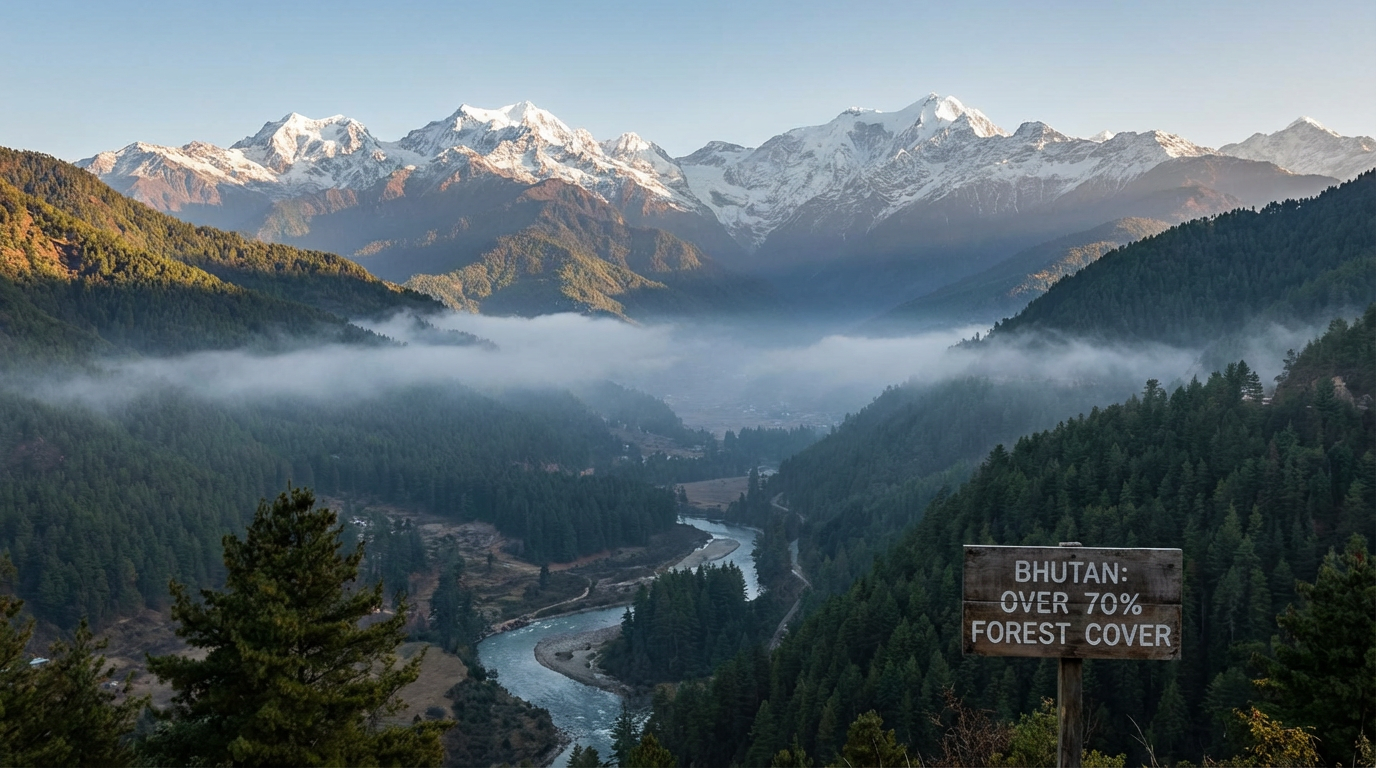
This image was generated with AI.
Bhutan's Unique Path
Bhutan has consciously rejected the conventional development model. Instead of maximizing Gross Domestic Product, the country measures its progress through Gross National Happiness. This philosophy is not romantic folklore – it shapes all political decisions, from tourism to energy policy. And it is anchored in the constitution.
| Aspect | Bhutan | Conventional Approach |
|---|---|---|
| Development Measure | Gross National Happiness (GNH) | Gross Domestic Product (GDP) |
| Priority | Happiness and Well-being | Economic Growth |
| Environmental Protection | Constitutional Rank (min. 60% Forest) | Often Secondary |
| Tourism | High Value, Low Volume | Maximizing Visitor Numbers |
| Carbon Footprint | Carbon-Negative | Usually Positive (CO2 Emitter) |
Gross National Happiness (GNH)
Gross National Happiness (GNH) was introduced in 1972 by the Fourth King Jigme Singye Wangchuck as an alternative to GDP. The fundamental idea: economic growth alone does not make people happy. Since 2008, GNH is anchored in the Bhutanese constitution and serves as the basis for all political decisions – from education policy to tourism.
"We aim to promote growth that is balanced with social development, sustainable environmental protection, and the preservation of our culture."
– Prime Minister Tshering Tobgay, 2015
The Four Pillars of GNH
Gross National Happiness is based on four fundamental pillars that cover all areas of life and must be kept in balance.
| Pillar | Meaning |
|---|---|
| 1. Sustainable Development | Economic growth in harmony with the environment |
| 2. Environmental Protection | Preservation of natural resources for future generations |
| 3. Preservation of Culture | Protection of cultural heritage and traditions |
| 4. Good Governance | Transparent, just and participatory administration |
The Nine Domains of the GNH Index
Unlike many sustainability goals, GNH in Bhutan is actually measured. Regular surveys cover nine domains of life:
- Psychological Well-being
- Health
- Education
- Time Use
- Cultural Diversity and Resilience
- Good Governance
- Community Vitality
- Ecological Diversity and Resilience
- Living Standards
The Only Carbon-Negative Country in the World
Carbon-negative means a country absorbs more carbon dioxide from the atmosphere than it emits. Bhutan is the only country in the world that achieves this balance – and by a significant margin. Extensive forests absorb approximately three times as much CO2 as the country produces. A unique distinction that Bhutan committed to preserving permanently in the Paris Agreement.
Carbon Footprint in Detail
Several factors enable this unique balance:
- Extensive Forests: Over 70 percent of the country is forested and continuously binds CO2.
- Low Industrialization: Bhutan has no heavy industry – the economy is based on agriculture, crafts, and tourism.
- Renewable Energy: 100 percent of electricity comes from hydropower.
- Small Population: Approximately 780,000 inhabitants across an area larger than Switzerland.
100% Renewable Energy
Bhutan's entire electricity supply is based on hydropower. Himalayan rivers provide so much energy that Bhutan exports surplus power to India – an important economic factor and a contribution to regional energy transition.
| Aspect | Details |
|---|---|
| Power Source | 100 Percent Hydropower |
| Export | Bhutan exports surplus electricity to India |
| Fossil Fuels | Minimal, primarily for transportation |
Forest Protection with Constitutional Rank
Bhutan is the only country in the world that guarantees environmental protection in its constitution. Article 5 stipulates that at least 60 percent of the country's land must remain permanently forested – forever. Currently, forest coverage stands at over 70 percent, a record in Asia. No other country has anchored nature conservation so binding.
National Parks and Protected Areas
Over half of Bhutan is under nature protection. A network of national parks, wildlife sanctuaries, and biological corridors protect the unique fauna and flora of the Himalayan kingdom.
| National Park | Size | Highlights |
|---|---|---|
| Jigme Dorji | 4,316 km² | Largest park, home to snow leopards |
| Jigme Singye Wangchuck | 1,730 km² | Black-necked cranes |
| Royal Manas | 1,057 km² | Tigers, elephants – UNESCO World Heritage |
| Thrumshingla | 768 km² | Red pandas, rare orchids |
| Bumdeling | 1,520 km² | Winter habitat for black-necked cranes |
A special feature of Bhutan are the biological corridors that connect all protected areas. This allows tigers, snow leopards, and elephants to roam freely between parks – a globally unique concept for protecting migratory species.
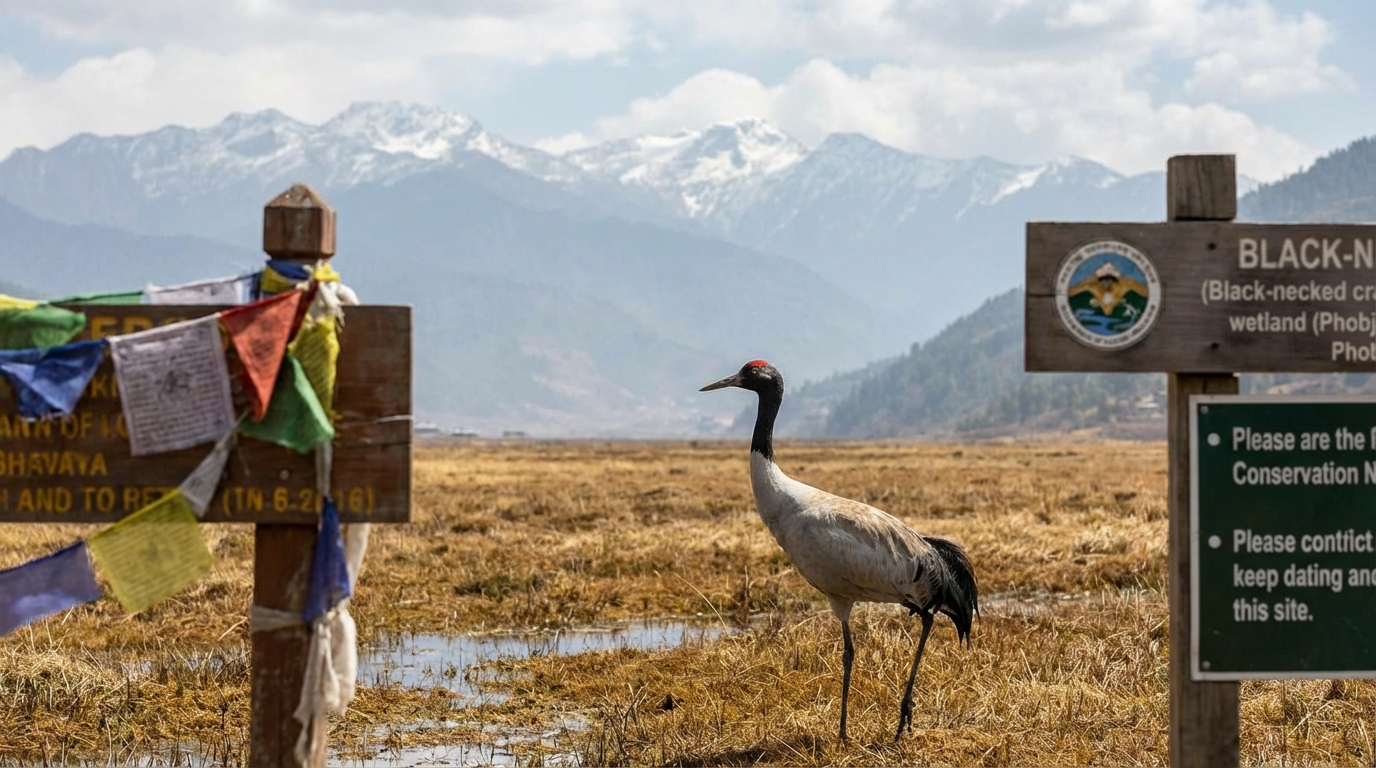
This image was generated with AI.
Biodiversity in Bhutan
The protected habitats are home to exceptional biodiversity. Bhutan is one of the world's biodiversity hotspots – across a relatively small area are ecosystems ranging from subtropical jungle to eternal ice.
| Category | Number of Species |
|---|---|
| Plants | approximately 5,600 |
| Birds | approximately 770 |
| Mammals | approximately 200 |
| Butterflies | over 300 |
Concrete Environmental Measures
Bhutan does not rest on its laurels. The country is a pioneer in environmental protection – often decades ahead of other nations. Some measures are globally unique.
| Measure | Since/Status | Details |
|---|---|---|
| Plastic Bag Ban | 1999 | First nationwide ban in the world |
| Single-Use Plastic Ban | 2019 Strengthened | Strict enforcement throughout the country |
| Tobacco Sales Ban | 2004 | First country with total sales ban |
| Car-Free Days | Regular | Especially in the capital Thimphu |
| Organic Farming | Goal: 100 Percent | Gradual transition to organic cultivation |
High Value, Low Volume: The Tourism Model
Bhutan has consciously rejected mass tourism. The "High Value, Low Volume" principle means: Fewer visitors, but meaningful encounters. The Sustainable Development Fee (SDF) is the tool to maintain this balance – and simultaneously finances Bhutan's social and environmental programs.
| For Bhutan | For Travelers |
|---|---|
| No mass tourism, no overcrowding | Authentic experiences without crowds |
| Protection of culture and environment | Pristine nature and living traditions |
| Sustainable income rather than overtourism | Quality over quantity in accommodations and guides |
| Financing of social programs | The feeling of making a positive contribution |
How the SDF Contributes to Environmental Protection
The Sustainable Development Fee of 100 USD per night is not a tourist tax, but an investment in Bhutan's future. Revenue flows directly into programs that preserve the country for future generations.
| Sector | Use |
|---|---|
| Education | Free school education, scholarships for foreign studies |
| Health | Free healthcare system for all Bhutanese |
| Environment | Rangers, wildlife protection, reforestation programs, climate research |
| Culture | Restoration of Dzongs and temples, promotion of traditional arts |
| Infrastructure | Sustainable development of rural regions |
| Youth | Training and mentoring programs |
All Details on the SDF: Calculation, Reductions and Use
Tips for Respectful Travel
As a guest in Bhutan, you can actively contribute to preserving this unique country. The following tips help you travel respectfully – for the environment, the culture, and the people around you.
Environmentally Conscious Behavior
| Recommendation | Details |
|---|---|
| Reusable Water Bottle | Avoid plastic bottles – hotels are happy to refill |
| Take Trash with You | Leave nothing in nature, especially on hikes |
| Save Water | Short showers, reuse towels multiple times |
| Local Products | Bhutanese souvenirs instead of imported mass goods |
| Save Energy | Turn off lights and heating when you leave the room |
Cultural Respect
| Situation | Recommendation |
|---|---|
| Clothing in Temples/Dzongs | Cover shoulders and knees, no short pants or tops |
| Photography | Always ask for permission, forbidden in many temples |
| Monks | Treat with respect, do not touch |
| Prayer Wheels | Spin clockwise |
| Sacred Sites | Do not sit on walls, remove shoes if asked |
Detailed Guide: Clothing and Etiquette in Bhutan
Social Responsibility
| Action | Impact |
|---|---|
| Appropriate Tipping | Direct support for guides, drivers, and hotel staff |
| Choose Homestays | Income goes directly to village communities |
| Book Local Guides | Creates jobs and promotes knowledge transfer |
| Pay Fair Prices | Do not haggle over local products |
| Try Local Food | Supports local restaurants and farmers |
Frequently Asked Questions
Why is Bhutan the only carbon-negative country?
Bhutan combines over 70 percent forest coverage with low industrialization and 100 percent renewable energy from hydropower. The forests absorb approximately three times as much CO2 as the country produces. Additionally, the constitution requires maintaining at least 60 percent forest coverage – forever.
What is Gross National Happiness (GNH)?
Gross National Happiness is Bhutan's alternative to Gross Domestic Product. It measures development not by economic growth, but by the well-being of the population across nine domains – from health and environment to cultural vitality. The concept was introduced in 1972 and has been anchored in the constitution since 2008.
What is the SDF (Sustainable Development Fee) used for?
The SDF of 100 USD per night finances free education and healthcare for all Bhutanese, environmental protection programs, restoration of Dzongs and temples, and development of rural regions. Your travel costs are thus a direct contribution to Bhutan's sustainable development.
Since when has Bhutan had a plastic ban?
Bhutan was one of the first countries in the world to implement a national plastic bag ban in 1999. Since 2019, the ban has been extended to single-use plastics. At entry, plastic bags may be confiscated – bring reusable alternatives.
How can I contribute to sustainability as a tourist?
Use a reusable water bottle, leave no trash in nature, respect sacred sites and traditions, and buy local products. Most importantly: take time for genuine encounters instead of just checking off as many sights as possible.
Why is Bhutan tourism so expensive?
The "High Value, Low Volume" model is intentionally designed to prevent mass tourism. The SDF finances social and ecological programs. The seemingly high price protects exactly what makes Bhutan unique: pristine nature, living traditions, and authentic encounters without crowds.
What percentage of Bhutan is under nature protection?
Over 51 percent of the country's area is under nature protection – distributed across five national parks and four wildlife sanctuaries. Biological corridors connect all protected areas so animals can roam freely. The constitution additionally guarantees at least 60 percent forest coverage.
Related Topics for Your Travel Planning
Bhutan's sustainability philosophy shapes all aspects of travel. These topics help you with further planning:

This image was generated with AI.
SDF in Detail
Everything about the Sustainable Development Fee: calculation, discounts for children and what the fee is used for.
This image was generated with AI.
Clothing & Etiquette
Travel respectfully: dress code for temples, rules of conduct and cultural customs in Bhutan.
This image was generated with AI.
Phobjikha Valley
Experience nature conservation: the winter habitat of black-necked cranes and Bhutan's commitment to endangered species.
Experience Bhutan Sustainably
A trip to Bhutan is more than a vacation – it is a contribution to preserving a unique country. Let us advise you.