Combine Bhutan and Tibet: The Ultimate Himalayan Journey 2026
Last updated:
The combination of Bhutan and Tibet is the most demanding, yet also the most fascinating Himalayan journey. Both regions share Tibetan Buddhist roots and offer spectacular landscapes – yet differ significantly in accessibility and travel experience. Since there is no direct connection between Bhutan and Tibet, the route must necessarily go through Nepal. This page explains how to meaningfully combine both countries.
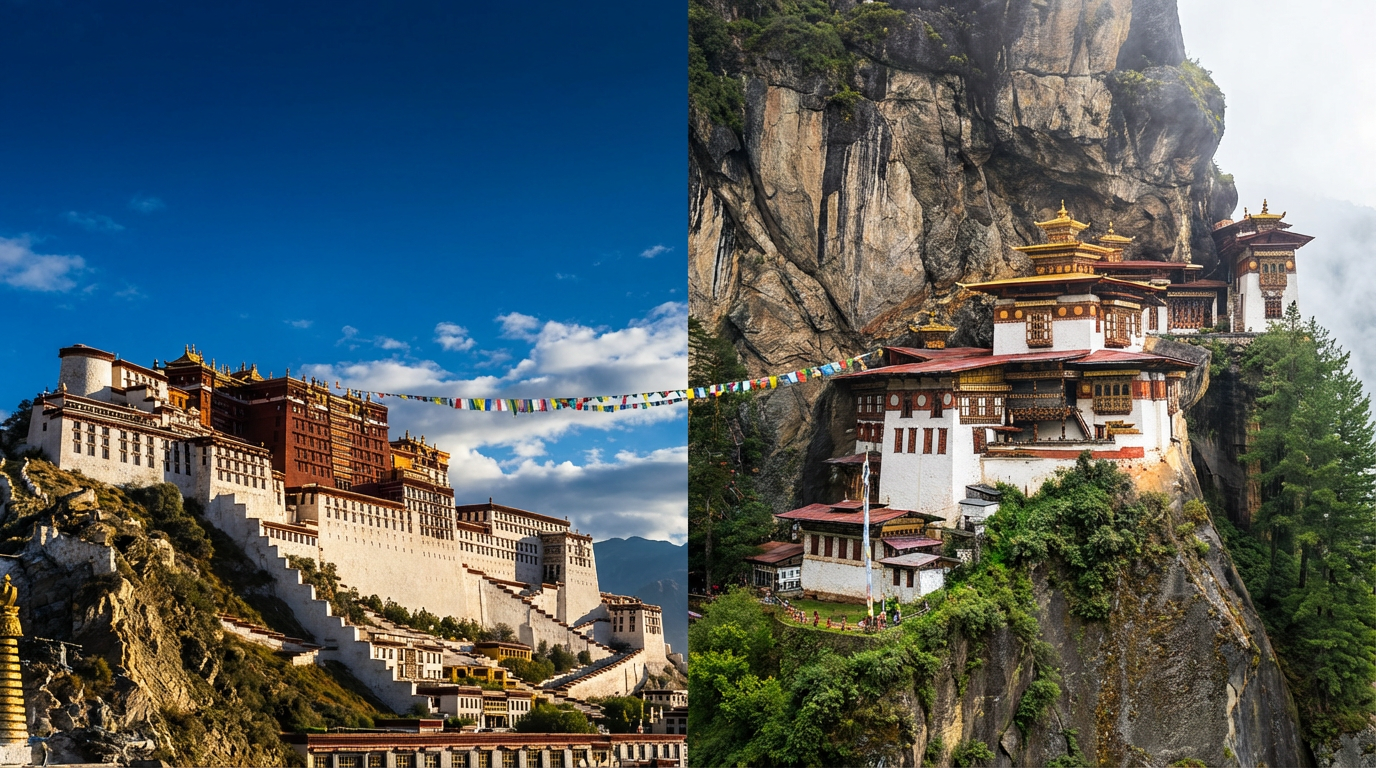
This image was generated with AI.
Important: No Direct Connection Between Bhutan and Tibet
Bhutan and China do not maintain diplomatic relations. Historical border disputes and the militarily sensitive location along the border make an opening unlikely in the foreseeable future. This makes Nepal the unavoidable hub for your combination journey.
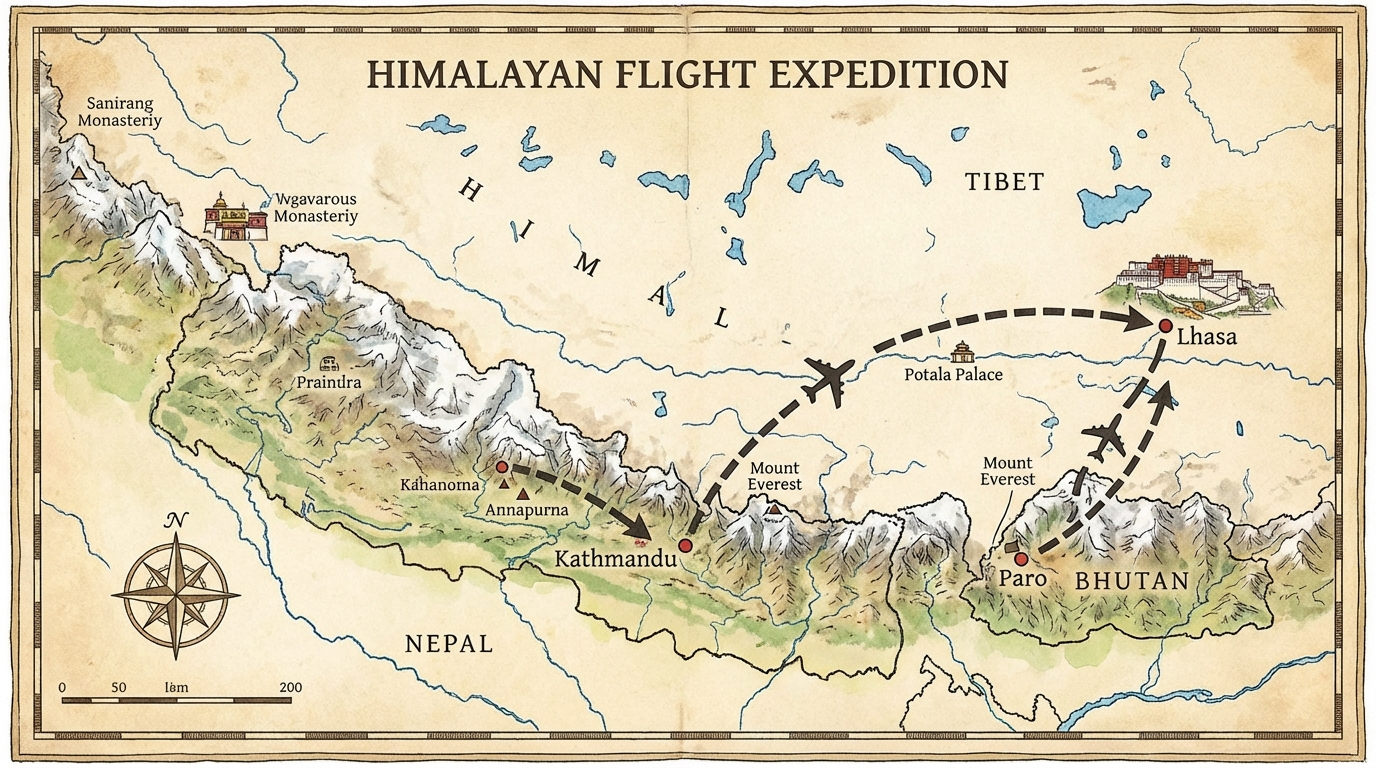
The Route via Nepal
Kathmandu is the natural hub for your Bhutan-Tibet combination. Flight times are short – Paro to Kathmandu takes just 1.25 hours, Kathmandu to Lhasa about 1.5 hours. However, the crucial factor is visa processing time: plan for at least 4 days in Kathmandu.
This image was generated with AI.
Travel Schedule Overview
- Bhutan to Nepal: Flight Paro - Kathmandu (approx. 1.25 hours) with Drukair or Bhutan Airlines
- Stay in Nepal: At least 4 days for Tibet visa processing. Use the time to explore Kathmandu – Boudhanath, Pashupatinath, Durbar Square
- Nepal to Tibet: Flight Kathmandu - Lhasa (approx. 1.5 hours) OR land route via Everest Base Camp (5-7 days)
Kathmandu - Lhasa Options
| Option | Duration | Costs | Special Feature |
|---|---|---|---|
| Flight | 1.5 hours | 400-700 USD | Fast, comfortable, spectacular Himalayan flight |
| Land route (via EBC) | 5-7 days | Included in tour package | Everest Base Camp (north side) included, gradual acclimatization |
Tibet Permit System Explained
Tibet requires a completely different travel concept than Bhutan. Independent travel is not possible – all tourists must book through a licensed Tibetan tour operator and are accompanied by a guide and driver. The operator handles permit acquisition.
Required Permits
1. Tibet Travel Permit (TTP)
- For: All international tourists
- Applied through: Licensed Tibet tour operator
- Processing time: Up to 20 days
- Documents: Passport scan (color, clearly legible)
- Collection: In Kathmandu or Lhasa
2. Chinese Group Visa
3. Aliens' Travel Permit (ATP)
- For: Areas outside Lhasa (Shigatse, Everest, Gyantse)
- Applied through: Tour operator on site
- Location: Issued in Tibet itself
4. Military Permit
- For: Border/sensitive areas (Mount Kailash, Mansarovar Lake)
- Note: Additional application required, longer lead time
Visa Timing and Planning
| Document | Timeline | Note |
|---|---|---|
| Bhutan Visa | 2-3 weeks before departure | Online via visit.doi.gov.bt |
| Tibet Travel Permit | 3-4 weeks ahead via operator | Passport scan required |
| Chinese Group Visa | In Kathmandu, 4-5 days before Tibet entry | Plan waiting time in Nepal |
| Nepal Visa | On arrival at airport | Straightforward, Visa on Arrival |
Detailed information on Bhutan visa
Acclimatization: Critical for This Journey
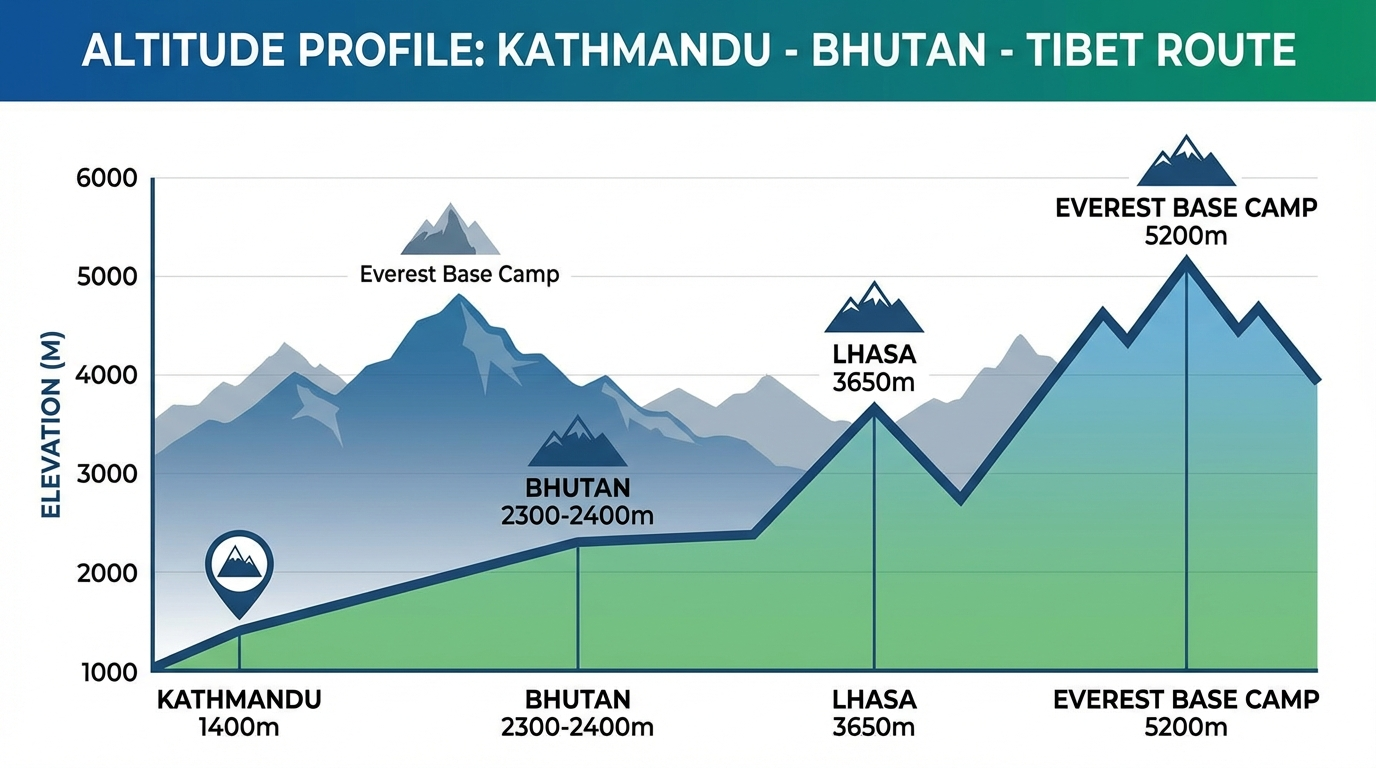
Altitude Profile of the Route
| Location | Altitude | Altitude Zone |
|---|---|---|
| Kathmandu (Nepal) | 1,400 m | Low – no acclimatization needed |
| Paro (Bhutan) | 2,300 m | Moderate – slight acclimation |
| Thimphu (Bhutan) | 2,400 m | Moderate |
| Lhasa (Tibet) | 3,650 m | High – acclimatization required! |
| Gyantse (Tibet) | 4,040 m | High |
| Shigatse (Tibet) | 3,840 m | High |
| Everest Base Camp (North) | 5,200 m | Very high – only for acclimatized! |
This image was generated with AI.
Acclimatization Strategy
The order of your journey significantly influences how well you acclimatize to altitude. With the right strategy, you can substantially minimize altitude sickness risk.
Recommended Strategy:
- Bhutan first: Gentle introduction at 2,300-3,100 m
- Kathmandu in between: "Recovery" at 1,400 m
- Tibet slowly: Land route preferred for gradual altitude gain
- Rest day in Lhasa: Don't overexert on the first day
Altitude Sickness Symptoms:
- Headaches
- Nausea, loss of appetite
- Insomnia
- Weakness, fatigue
- Shortness of breath
For severe symptoms: Immediate descent!
Medication Support
More on health and altitude sickness
Recommended Routes
Depending on your available time and interests, there are various ways to combine Bhutan and Tibet. Here we present three proven route variations.
Route A: Bhutan + Tibet Classic (12-14 Days)
The compact option for travelers with limited time. You see the highlights of both countries, but must forgo deeper exploration.
| Day | Location | Highlights |
|---|---|---|
| 1-2 | Paro | Arrival, Tiger's Nest hike, Paro Dzong |
| 3 | Thimphu | Buddha Dordenma, Memorial Chorten, Tashichho Dzong |
| 4 | Punakha | Punakha Dzong, Chimi Lhakhang |
| 5 | Flight Paro - Kathmandu | Transfer, arrival in Nepal |
| 6-9 | Kathmandu | Apply for Tibet visa, Boudhanath, Pashupatinath, Durbar Square |
| 10 | Flight Kathmandu - Lhasa | Arrival in Tibet (3,650 m!), rest for acclimatization |
| 11-12 | Lhasa | Potala Palace, Jokhang Temple, Barkhor, Sera Monastery |
| 13 | Lhasa | Drepung Monastery, Norbulingka |
| 14 | Departure | Flight Lhasa - Kathmandu - Home |
Route B: Extended via Land Route Nepal-Tibet (18-21 Days)
The comprehensive option for travelers who want the best of both worlds. The land route via Everest Base Camp enables gentle acclimatization and offers spectacular experiences. Our recommendation for anyone with sufficient time.
| Day | Location | Region |
|---|---|---|
| 1-5 | Paro, Thimphu, Punakha | Bhutan highlights |
| 6 | Flight Paro - Kathmandu | Transfer to Nepal |
| 7-10 | Kathmandu | Visa application, explore Nepal |
| 11 | Start land route | Kathmandu - Gyirong (border crossing) |
| 12-13 | Shigatse | Tashilhunpo Monastery |
| 14-15 | Everest Base Camp | Rongbuk Monastery, north side of Everest |
| 16-17 | Gyantse | Kumbum Stupa, Pelkor Chode |
| 18-19 | Lhasa | Potala, Jokhang, Barkhor |
| 20-21 | Departure | Flight Lhasa - Kathmandu - Home |
Route C: Tibet First, Then Bhutan (14-16 Days)
An alternative order where you visit Tibet first and then "relax" in Bhutan. Advantage: You end your journey at lower altitude. Disadvantage: The direct entry into altitude is more demanding.
| Day | Activity |
|---|---|
| 1-2 | Arrival via Kathmandu to Lhasa (acclimatization!) |
| 3-7 | Tibet tour: Lhasa, Shigatse, Gyantse, Yamdrok Lake |
| 8 | Flight Lhasa - Kathmandu |
| 9 | Kathmandu – recovery, "altitude descent" |
| 10 | Flight Kathmandu - Paro |
| 11-15 | Bhutan tour: Paro, Thimphu, Punakha, Tiger's Nest |
| 16 | Departure from Paro |
Highlights in Tibet
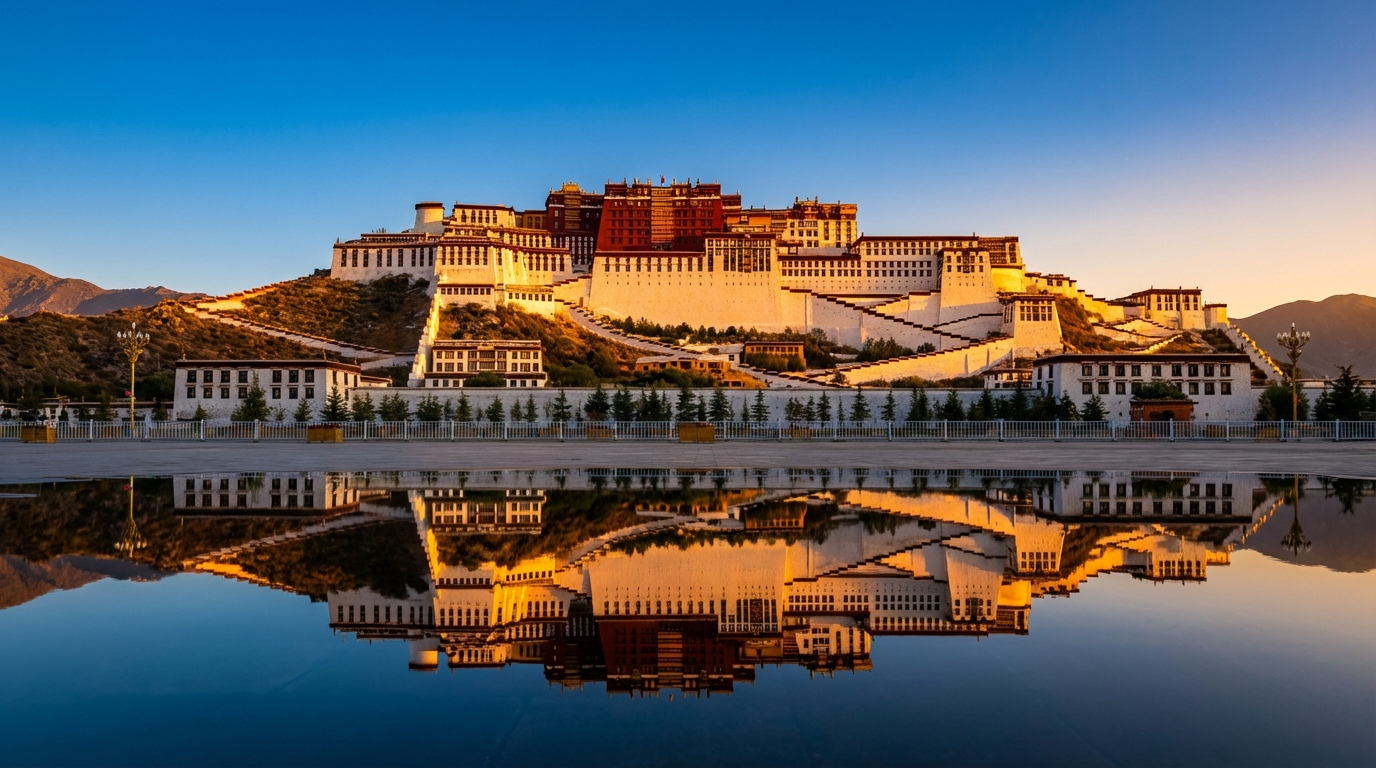
Tibet is the "roof of the world" – a high plateau full of spiritual power and breathtaking landscapes. Despite the political situation, the cultural treasures remain accessible and overwhelming.
This image was generated with AI.
Lhasa – The Holy City
- Potala Palace: Tibet's iconic landmark, former winter residence of the Dalai Lama, UNESCO World Heritage Site
- Jokhang Temple: Tibet's holiest sanctuary, destination of countless pilgrims, daily ritual circumambulation (Kora)
- Barkhor: The pilgrimage path around Jokhang, vibrant market, authentic street life
- Sera Monastery: Famous for afternoon monk debates – a fascinating spectacle
- Drepung Monastery: Once the world's largest monastery with over 10,000 monks
Outside Lhasa
- Shigatse – Tashilhunpo Monastery: Seat of the Panchen Lama, second most important spiritual authority of Tibetan Buddhism
- Gyantse – Kumbum Stupa: Unique multi-story stupa with over 100 chapels and 10,000 wall paintings
- Yamdrok Lake: Sacred turquoise glacial lake at 4,440 m, breathtaking panorama
- Everest Base Camp (North): The less-visited Tibetan side of Everest, Rongbuk Monastery at 5,154 m
Bhutan vs. Tibet: The Differences
Although Bhutan and Tibet share the same Buddhist roots, the travel experiences differ fundamentally. The contrast is precisely what makes a combination appealing.
| Aspect | Bhutan | Tibet |
|---|---|---|
| Political Situation | Independent kingdom, stable monarchy | Autonomous region of China, restricted freedoms |
| Travel Freedom | Since 2022 partially independent possible | Only with guide and driver, no independent travel |
| Altitude | 2,000-3,100 m (moderate) | 3,600-5,200 m (high to very high) |
| Landscape | Green valleys, forests, subtropical to alpine | High plateau, barren, wide steppes, lakes |
| Buddhism | Vibrant tradition, integrated into daily life | Despite repression present, deep spirituality |
| Architecture | Dzongs (fortress-monasteries), colorful wooden buildings | Potala Palace, massive monasteries, white walls |
| Authenticity | Unspoiled, minimal western influence | Partly modernized/Chinese influenced |
| Lead Time | 2-3 weeks for visa | 3-4 weeks for permits |
Costs of a Combination Journey
A Bhutan-Tibet combination is an investment. Costs comprise multiple components – visas, fees, tours, and flights. Here's a realistic calculation for a 14-day journey.
| Item | Costs | Note |
|---|---|---|
| Bhutan SDF (5 nights) | 500 USD | 100 USD/night until August 2027 |
| Bhutan Visa | 40 USD | One-time, non-refundable |
| Bhutan Tour (5 days) | 1,200-1,600 USD | Guide, accommodation, transport, meals |
| Flight Paro - Kathmandu | ca. 240 USD | Drukair or Bhutan Airlines |
| Kathmandu (4 nights) | 200-400 USD | Hotel + meals |
| Chinese Group Visa | 120-150 USD | Processing in Kathmandu |
| Tibet Tour (6 days incl. permit) | 1,150-1,500 USD | Guide, driver, hotels, permits |
| Flight Kathmandu - Lhasa | 500-700 USD | Depending on season |
| Flight Lhasa - Kathmandu | 500-700 USD | Return flight |
| Total on site | 4,450-5,590 USD | Per person |
Additionally: International Flights
- Europe - Kathmandu: 600-1,000 USD
- Return flight from Kathmandu or Paro – depending on route
Detailed cost breakdown for Bhutan trips
Best Time to Travel
The combination of Bhutan and Tibet requires a timeframe that works for both destinations. Fortunately, the optimal travel months overlap.
| Period | Tibet | Bhutan | For Combination |
|---|---|---|---|
| March - May | Good – warm, before monsoon | Good – rhododendron bloom, pleasant | Recommended |
| June - August | Possible – monsoon milder than Nepal | Monsoon – heavy rain, difficult roads | Not ideal |
| September - November | Optimal – clear, stable, best visibility | Optimal – festivals, clear visibility | Best time! |
| December - February | Difficult – cold, passes partly closed | Possible – cold but sunny | Not recommended |
More on the best time to visit Bhutan
Practical Tips
Planning and Booking
- Book early: Tibet permits need 3-4 weeks lead time, longer during peak season
- Kathmandu stay: Plan for at least 4 days for visa processing – use the time for Nepal
- Flexibility: The permit situation in Tibet can change – have a Plan B
- Tour operators: Book with an operator experienced in both destinations
Health and Insurance
- Medical consultation: See a tropical medicine doctor before traveling – altitude fitness, medications, vaccinations
- Travel insurance: Definitely with altitude sickness coverage and evacuation protection
- Evacuation insurance: Essential – helicopter evacuation from Tibet can cost over 50,000 USD
- Travel pharmacy: Diamox (prescription!), pain relievers, diarrhea medication, sunscreen
What's Not Possible
Frequently Asked Questions
Can you travel directly from Bhutan to Tibet?
No, that's not possible. The border between Bhutan and Tibet is closed, with no road, train, or flight connections. All combination journeys must be routed via Nepal (Kathmandu).
How long does applying for all visas take?
Plan for 4-5 weeks total lead time. The Bhutan visa takes 2-3 weeks, the Tibet Travel Permit 3-4 weeks. The Chinese Group Visa is applied for in Kathmandu (4-5 working days), which is why you must plan a stay there.
Is the journey suitable for less fit people?
The Bhutan-Tibet combination is demanding. Altitude over 3,500 m in Tibet stresses the body regardless of fitness. If you're healthy and acclimatize slowly, the journey is manageable – but definitely consult a doctor beforehand. This journey is not recommended for people with heart or lung conditions.
Which route is better – Bhutan or Tibet first?
We recommend "Bhutan first." The reason: In Bhutan you gradually adjust to moderate altitudes (2,300-3,100 m) before making the larger jump to Tibet (3,650 m+). Plus, you need time in Kathmandu for the Tibet visa, which works perfectly as a "stopover."
Can you travel independently in Tibet like in Bhutan?
No. Independent travel in Tibet is not possible for international tourists. You must book through a licensed tour operator and are accompanied throughout by a guide and driver. The itinerary is predetermined. In Bhutan, since 2022, you can move freely in the Paro-Thimphu-Punakha corridor.
When is the best time to travel for both countries?
October and November are optimal – clear visibility, stable weather in both countries, and important festivals take place in Bhutan. As a second choice, March to May (Himalayan spring) works. We advise against June to August (monsoon) and December to February (cold, closed passes).
What are realistic total costs?
For a 14-day combination plan approx. 5,500-7,000 USD per person (including international flights). For longer routes (18-21 days with Everest Base Camp) the budget increases to 7,000-9,000 USD.
Is it safe to travel to Tibet?
Tibet is safe for tourists in terms of crime – it's very low. The main risks are altitude sickness and political uncertainties (Tibet can be closed to tourists on short notice, e.g., around sensitive dates). Check the current situation shortly before your trip.
Related Routes and Topics
Discover more combination options and deepen your knowledge for perfect trip planning.
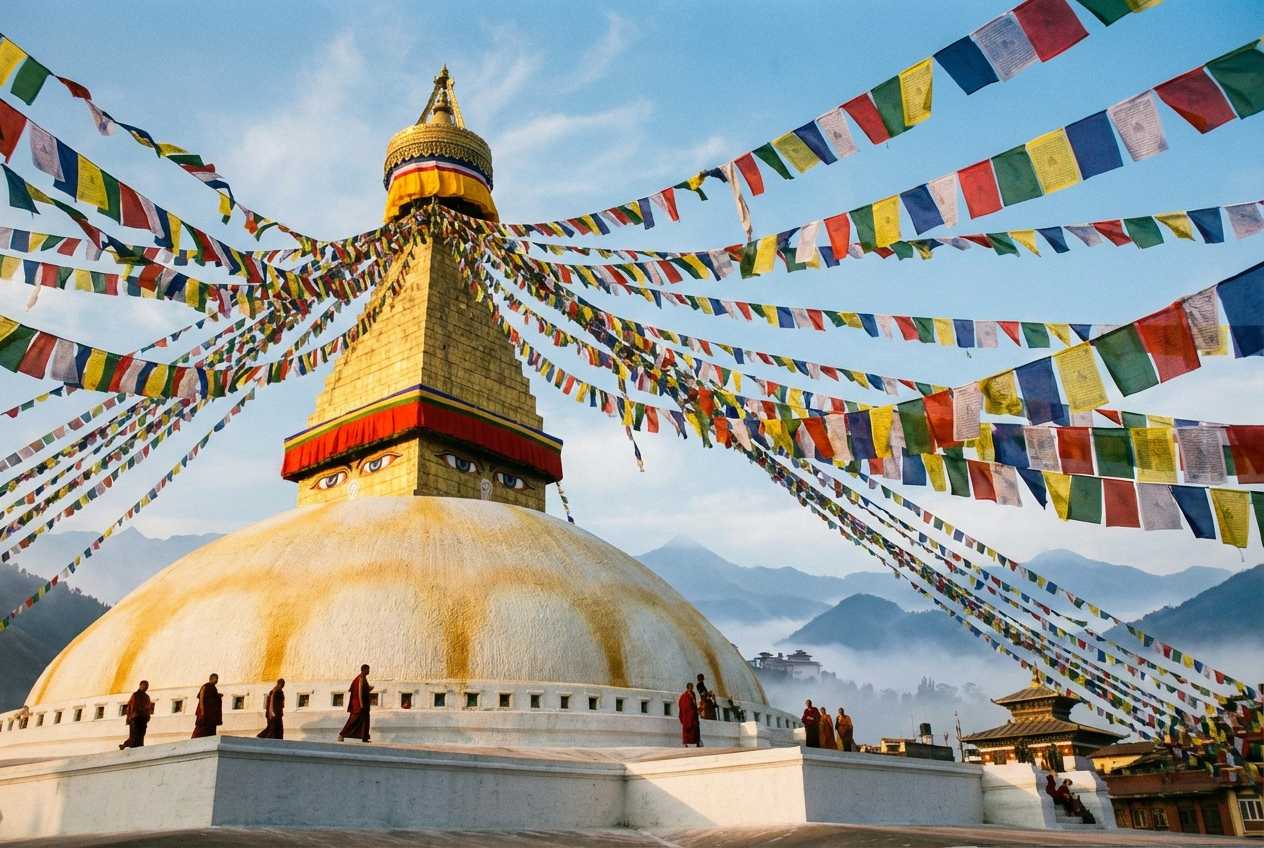
This image was generated with AI.
Bhutan + Nepal
The easier Himalayan combination: Two countries, uncomplicated logistics.
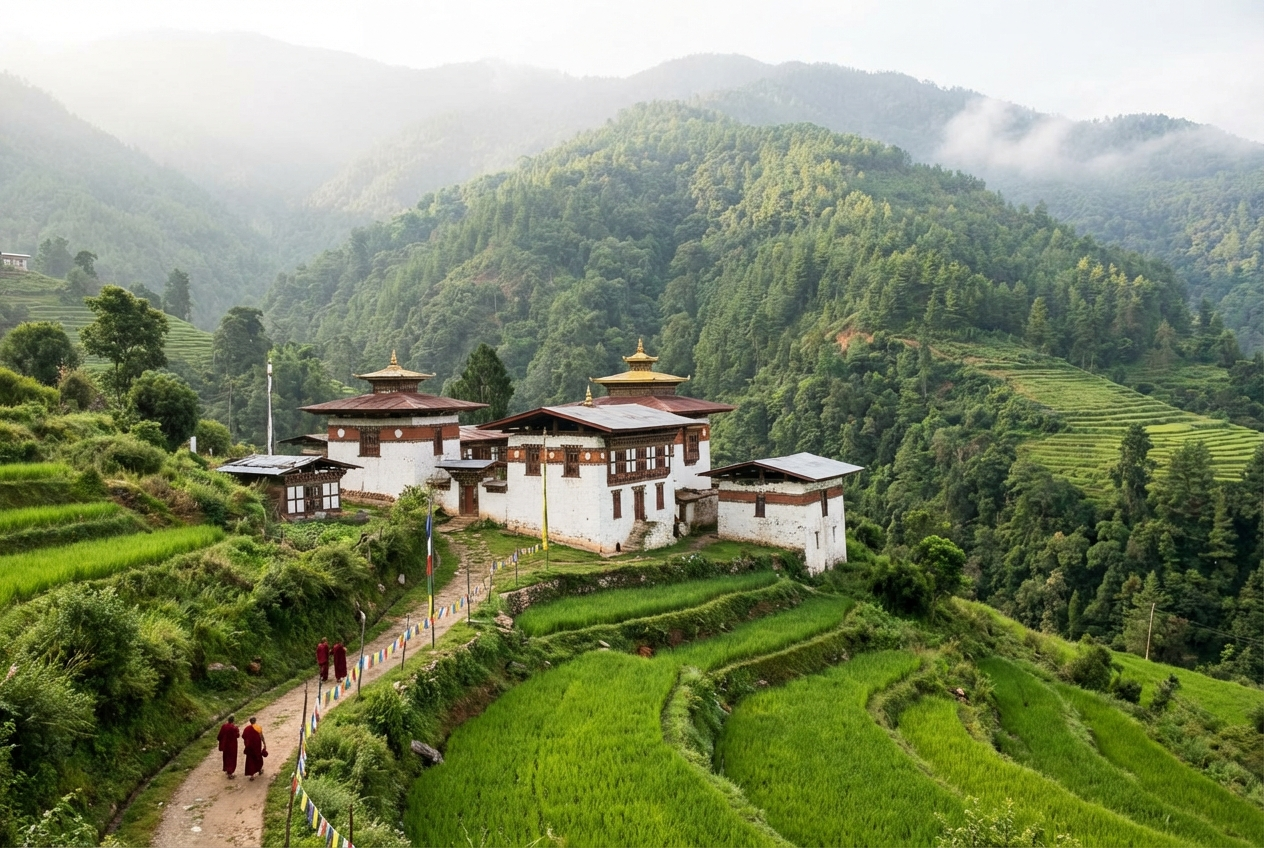
This image was generated with AI.
Extended Bhutan (14-21 Days)
If you want to spend more time in Bhutan itself: Eastern Bhutan and remote regions.
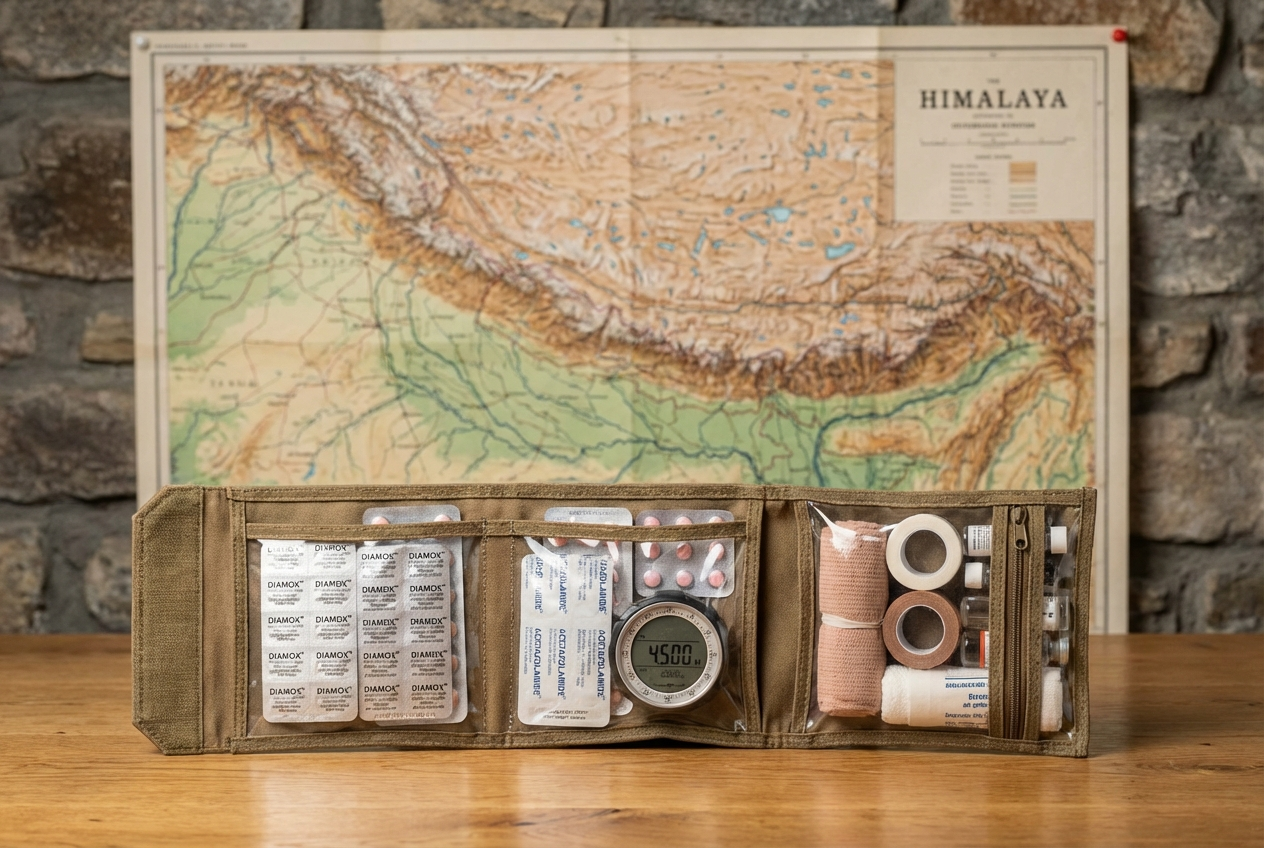
This image was generated with AI.
Health & Altitude Sickness
Everything on vaccinations, acclimatization, and medical preparation.
Bhutan and Tibet – ready for the ultimate journey?
This demanding combination requires careful planning. We advise you personally on routes, timing, and all logistical questions.