Bhutan Currency 2026: Ngultrum, Exchange Rates & Tipping Guide
Last updated:
The Ngultrum (BTN) is the official currency of the Kingdom of Bhutan and is pegged to the Indian Rupee. Since accommodation, meals, and transport on organized tours are already paid in advance, you'll need less cash on-site than you might expect – primarily for tips, souvenirs, and personal expenses. This guide shows you how to be financially prepared for your Bhutan journey.
Key Facts at a Glance
The Ngultrum: Bhutan's Currency
The Ngultrum (ISO code: BTN) is the official currency of the Kingdom of Bhutan and is issued by the Royal Monetary Authority of Bhutan. One Ngultrum is subdivided into 100 Chertum, though this subunit is rarely used in everyday transactions.
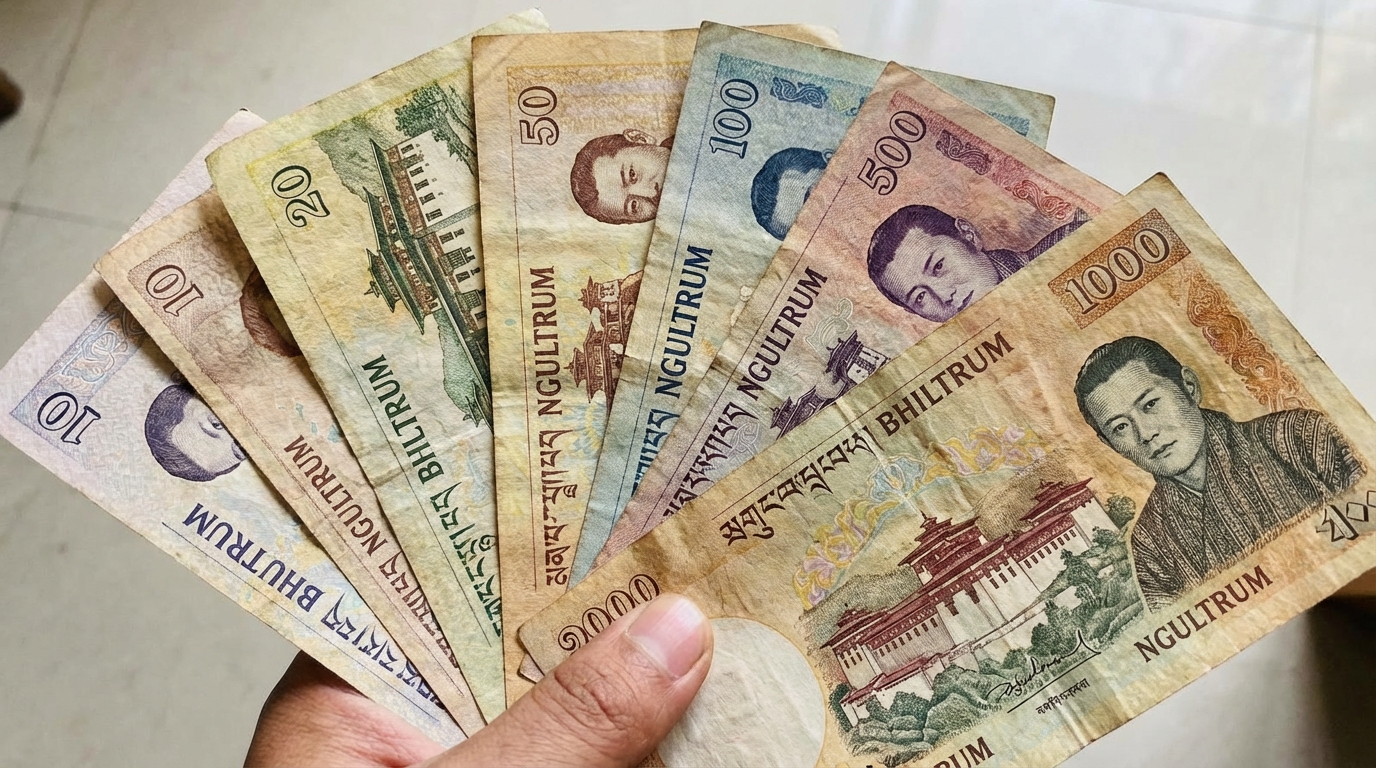
This image was generated with AI.
Current Exchange Rates
The following exchange rates are for orientation and may fluctuate. We recommend checking the current rate shortly before your trip.
| Currency | Rate to BTN | Example |
|---|---|---|
| Euro (EUR) | 1 EUR = approx. 95 BTN | 100 EUR = approx. 9,500 BTN |
| Swiss Franc (CHF) | 1 CHF = approx. 100 BTN | 100 CHF = approx. 10,000 BTN |
| US Dollar (USD) | 1 USD = approx. 85 BTN | 100 USD = approx. 8,500 BTN |
Link to Indian Rupee
The Ngultrum is pegged 1:1 to the Indian Rupee (INR). This means Indian Rupees are accepted as payment in Bhutan. An important caveat: 500 and 1,000 Rupee notes are often not accepted. Conversely, Bhutanese Ngultrum are not accepted as payment in India.
Banknotes and Coins
In everyday use, you'll primarily encounter banknotes. Coins (Chertum) do exist, but they are very rare in daily transactions and you're unlikely to encounter them.
| Denomination | Color | Motif |
|---|---|---|
| 1 Nu | Green | Dragon |
| 5 Nu | Blue | Dzong |
| 10 Nu | Orange | Taktsang (Tiger's Nest) |
| 20 Nu | Green | Punakha Dzong |
| 50 Nu | Purple | Trongsa Dzong |
| 100 Nu | Blue | Tashichho Dzong |
| 500 Nu | Red | Paro Airport |
| 1,000 Nu | Green | Royal Palace |
How Much Cash to Bring?
Since your tour package (accommodation, meals, transport) is already paid in advance, you'll need less cash on-site than you might expect. You'll primarily need cash for tips, souvenirs, and personal expenses like beverages between meals.
Recommended Cash Amounts
| Trip Duration | Recommended Amount | Use |
|---|---|---|
| 7 Days | 200–300 EUR | Tips, souvenirs, extras |
| 14 Days | 400–500 EUR | Tips, souvenirs, personal expenses |
| 21 Days | 600–800 EUR | As above, plus reserve |
Which Currency to Bring?
| Currency | Recommendation | Notes |
|---|---|---|
| Euro (EUR) | Highly Recommended | Easy to exchange, good rates |
| US Dollar (USD) | Recommended | Internationally recognized, preferred for tips |
| Swiss Franc (CHF) | Accepted | Exchange possible, but less common |
Exchanging Money On-Site
Bhutanese banks offer the best exchange rates. The most convenient place to exchange is at Paro Airport upon arrival, where two exchange counters are available. Be aware of the limited business hours of banks in the country.
| Location | Rate | Hours |
|---|---|---|
| Bank of Bhutan | Best Rates | Mon–Fri 9:00–15:00, Sat 9:00–12:00 |
| Bhutan National Bank | Good Rates | Mon–Fri 9:00–15:00, Sat 9:00–12:00 |
| Paro Airport | Good Rates | Open for flight arrivals |
| Hotels | Worse Rates | Varies |
Exchanging Ngultrum Back
Exchanging Ngultrum back into EUR or other currencies is difficult and only possible at Paro Airport. Therefore, exchange only as much money as you actually need.
ATMs in Bhutan
ATMs are available in Bhutan, but their availability is limited. We recommend treating ATMs as an emergency backup, not your primary cash source. Problems with empty machines or technical issues are not uncommon.
| Location | Availability | Notes |
|---|---|---|
| Paro Airport | Yes | Convenient upon arrival |
| Thimphu | Multiple ATMs | Best availability in the country |
| Paro Town | Yes | Limited selection |
| Punakha | Limited | Not always functional |
| Bumthang | Limited | Plan for backup funds |
| East Bhutan | Very Limited | Definitely withdraw cash beforehand |
Cards Accepted at ATMs
| Card Type | Acceptance |
|---|---|
| Visa | Yes, at most ATMs |
| Mastercard | Yes, at most ATMs |
| Maestro/Cirrus | Yes |
| V-Pay | No – NOT accepted |
| American Express | Rarely |
Credit Cards: Where They Work
Credit card acceptance in Bhutan is significantly more limited than in Western countries. While luxury hotels and some larger shops in Thimphu and Paro accept credit cards, cash is the standard payment method in everyday life.
| Situation | Acceptance |
|---|---|
| Luxury Hotels (Aman, Six Senses) | Yes |
| Larger Hotels in Thimphu/Paro | Usually Yes |
| Smaller Hotels | Rarely |
| Restaurants in Towns | Limited |
| Shops and Markets | Rarely |
| Rural Areas | No |
Which Credit Cards Are Accepted?
| Card | Acceptance |
|---|---|
| Visa | Most Widely Accepted |
| Mastercard | Well Accepted |
| American Express | Rarely Accepted |
| Diners Club | Not Accepted |
Tipping Guide: Guides, Drivers, and Hotels
Tipping is not traditionally rooted in Bhutan, but is expected by international tourists and greatly appreciated by recipients. It's a nice way to express your appreciation for good service.
Recommended Tipping Amounts
| Recipient | Per Day | Per Week |
|---|---|---|
| Guide | 8–10 USD | approx. 50–70 USD |
| Driver | 5–8 USD | approx. 35–50 USD |
| Hotel Staff | 1–2 USD | – |
| Restaurant (if not included) | 5–10% of bill | |
Tipping on Trekking Tours
| Person | Recommended Amount |
|---|---|
| Trekking Team (total) | approx. 40 EUR per week |
| Porter (per day) | 3–5 USD |
| Cook (per day) | 5–8 USD |
When and How to Tip?
- Timing: At the end of your trip or the relevant service period
- Presentation: In person, for longer trips preferably in an envelope
- Currency: USD are often preferred, local currency is also welcome
- Kind Words: A few kind words of thanks are appreciated
US Dollar as Secondary Currency
Money-Saving Tips
Recommended
- Exchange at airport: Convenient and good rates
- Bring small notes: Easier to exchange
- Don't exchange too much: Exchange back is cumbersome
- Credit card as backup: Not as primary payment method
- Tips in USD: Often preferred
- Keep exchange receipt: For potential exchange back
Avoid
- Street money exchange: Illegal and risky
- Large amounts of Ngultrum back: Difficult to exchange
- Relying only on credit card: Acceptance very limited
- Bringing large notes: Hard to exchange
- Treating ATMs as main source: Unreliable
Typical On-Site Prices
To give you an idea of on-site prices, here are some typical costs for items and services not included in your tour package:
| Item/Service | Price (approx.) |
|---|---|
| Bottle of Water (0.5 L) | 30–50 BTN (approx. 0.30–0.50 EUR) |
| Local Beer | 100–150 BTN (approx. 1–1.50 EUR) |
| Coffee | 150–250 BTN (approx. 1.50–2.50 EUR) |
| Souvenir T-Shirt | 500–1,000 BTN (approx. 5–10 EUR) |
| Hand-Woven Scarf | 1,000–5,000 BTN (approx. 10–50 EUR) |
| Traditional Mask | 3,000–20,000 BTN (approx. 30–200 EUR) |
| SIM Card | 100–200 BTN (approx. 1–2 EUR) |
Import and Export Regulations
| Aspect | Regulation |
|---|---|
| Import Foreign Currency | Unlimited, but declare amounts over 10,000 USD |
| Export Foreign Currency | Max. amount imported |
| Import Ngultrum | Not permitted |
| Export Ngultrum | Only small amounts as souvenirs |
Frequently Asked Questions
Can I Pay with Euros in Bhutan?
No, Euros are not accepted as a payment method. You must exchange your Euros for Ngultrum on-site. This is possible at Paro Airport or at Bhutanese banks.
Do German Bank Cards Work at Bhutanese ATMs?
Visa and Mastercard debit cards work at most ATMs. However, V-Pay cards (common with German banks) are NOT accepted. Check what card type you have before your trip.
How Much Tip is Appropriate in Bhutan?
We recommend 8–10 USD per day for your guide and 5–8 USD per day for the driver. For a 7-day trip, that's approximately 50–70 USD for the guide and 35–50 USD for the driver. Tips are given in person at the end of the trip.
Should I Bring EUR or USD to Bhutan?
Both are useful. Euros exchange well and are suitable for currency exchange. US Dollars are practical for tips, as guides and drivers often prefer them. A combination of both is ideal.
Are Indian Rupees Accepted in Bhutan?
Yes, since the Ngultrum is pegged 1:1 to the Indian Rupee. However, 500 and 1,000 Rupee notes are often not accepted. Stick to smaller denominations. Conversely, Bhutanese Ngultrum are not accepted in India.
Can I Exchange Leftover Ngultrum Back?
Exchange back is difficult and only possible at Paro Airport. We recommend exchanging only as much as you expect to need. You can keep small notes as souvenirs.
Do I Need Cash if Everything is Pre-Paid?
Yes, you need cash for tips, souvenirs, beverages between meals, and personal expenses. Plan for approximately 200–300 EUR for a 7-day trip.
Further Information
With this knowledge, you're well-prepared for the financial aspects of your Bhutan trip. You might also be interested in these topics:

This image was generated with AI.
Costs & Budget
Complete cost breakdown for your Bhutan trip: SDF, flights, accommodation, and what you'll actually pay.
This image was generated with AI.
SDF Fees Explained
Everything about the Sustainable Development Fee: How much you pay, what the money is used for, and current discounts.
This image was generated with AI.
Visa & Entry
Apply for your e-visa, entry requirements, and what to expect at Paro Airport.
Ready for Your Bhutan Trip?
We're happy to advise you on all questions about currency, budget, and trip planning.